
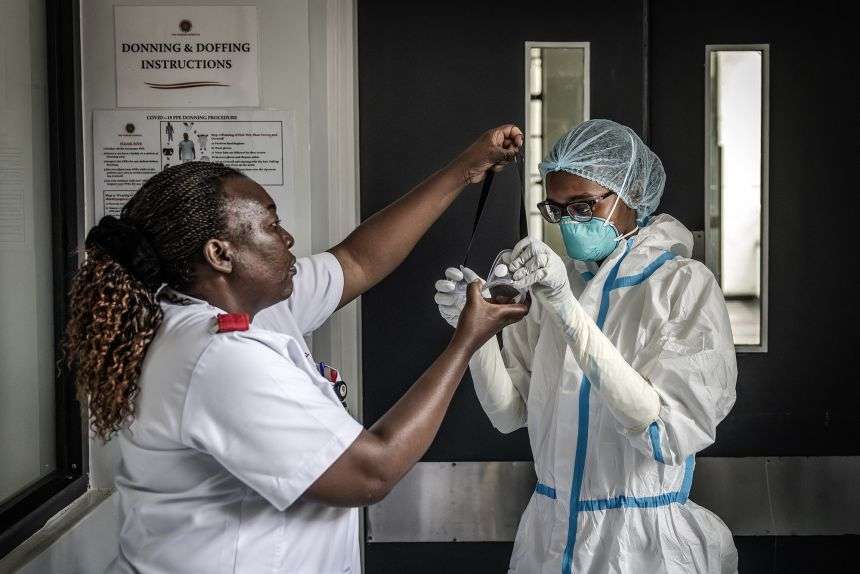
Kenya has confirmed four new cases of Ebola (Bundibugyo virus disease), bringing the total to seven, including the first patient, who died. Three of the new patients are health workers who treated the first case in hospital.
The Ministry of Health says the risk to the general public remains low. But this strain has no approved vaccine or treatment, so it is worth understanding what is happening.
What is Ebola?
Ebola is a severe and often deadly illness caused by a family of viruses first identified in 1976 in what is now DR Congo. Early symptoms often resemble flu, including fever, tiredness, headache, and muscle and joint pain.
Some patients later develop vomiting and diarrhoea. Ebola does not always cause bleeding. Because the early signs can look like malaria, laboratory testing is needed to confirm infection.
What is the Bundibugyo strain?
Bundibugyo virus is one of several Ebola-causing viruses. It is rarer than the Zaire strain behind the 2014–2016 West Africa epidemic.
Two earlier outbreaks, in Uganda in 2007 and DR Congo in 2012, killed roughly 30% to 50% of patients. Scientists say it appears milder than the Zaire strain, but it is still severe. They also caution that the figure comes from only two smaller outbreaks.
The main problem is the lack of medical tools.
The two approved Ebola vaccines target the Zaire virus, and no treatment is approved for Bundibugyo. Patients get supportive care, such as fluids and treatment of symptoms. The ministry says this care can improve a patient’s chances of survival.
The virus is behind a large outbreak in the region. More than 4,000 people have died in DR Congo this year, in what is the second most deadly known Ebola outbreak.
How does it spread?
Ebola spreads through direct contact with the blood or body fluids of a sick or deceased person. It does not spread through the air.
Incubation lasts 2 to 21 days, and people are usually not infectious until symptoms begin.
Fruit bats are the suspected natural source. Family members, caregivers and health workers are most at risk, as are people who handle bodies during funerals.
How did it get to Kenya?
The first patient was a Kenyan who had lived in DR Congo for seven years. He fell ill about a month earlier and was treated at several hospitals there. After that e travelled by road through Beni to Kampala, Uganda, on October 2. He then flew to Nairobi, landing at 1:10pm on Saturday, October 3, and passed routine public health screening.
A relative and a friend drove him to Nairobi Hospital, where he was isolated. And that was where the rain started beating us.
Doctors suspected a viral haemorrhagic fever because of his symptoms and travel history. His samples tested positive for Bundibugyo at two labs, the National Virology Reference Laboratory and KEMRI.
He unfortunately died on the night of October 5 and was buried on October 6 under Ebola safe burial rules. The WHO says it is unclear when he became symptomatic during the journey. Kenya became the fourth country to confirm the disease.
From one case to seven
Every later case is linked to the first patient. Each was already in quarantine when symptoms appeared.
| Case | Who | Key details |
|---|---|---|
| 1 | 40-year-old Kenyan man | Died October 5 |
| 2 | 39-year-old man, close relative of Case 1 | Developed symptoms in quarantine on October 13. Stable |
| 3 | 65-year-old woman, close relative of Cases 1 and 2 | Quarantined since October 6. Confirmed October 16. Receiving care |
| 4 | Male relative of Case 1 | Quarantined since October 6. Confirmed October 17 |
| 5–7 | Three health workers: two men and a woman, aged 29, 35 and 32 | Treated Case 1 on October 3–4. Quarantined since October 9. Confirmed October 17 |
The ministry has not named any patients. Its public statements so far do not explain how the health workers were infected. It says early detection of all four new cases limited the risk of further spread.
What is the government doing?
- Contact tracing: 128 of 130 identified contacts (98.5%) are traced and quarantined, above the 85% benchmark for breaking transmission.
- Treatment capacity: Five hospitals have 241 beds designated for Ebola: Kenyatta National, Moi Teaching and Referral, National Police Service, Port Reitz and Nairobi Hospital. There are 15 isolation and treatment units nationwide, with plans to expand to 22.
- Testing: Five labs, including mobile ones, return results in 6 to 12 hours.
- Screening: 685,027 people had been screened by October 15. Travellers from 10 high-risk countries must complete a digital form and show a QR code on arrival. Flights from those countries use a dedicated screening gate at JKIA.
- Preparedness: 4,971 health workers have been trained. Protective equipment has gone to 28 high-risk counties and entry points.
- No restrictions: The government says there are no limits on travel, trade or public gatherings.
What are the risks?
The ministry says there is no evidence of community transmission. Experts urge caution. Africa CDC says new cases among known contacts are less worrying than cases with unknown links, which could mean hidden spread.
Pathologist Dr Ahmed Kalebi argues Kenya has entered a phase of local transmission and that containment is not yet assured.
Specific risks include:
- More cases may still appear among people already in quarantine until their 21-day monitoring ends. The clock restarts for anyone exposed to a newly confirmed patient.
- Two contacts are still untraced.
- Informal border crossings sit outside the 15 screening points of entry.
- Early symptoms look like malaria or flu, so cases can be missed.
- Health workers are exposed: three of the seven patients are in this group.
How to protect yourself
- Do not touch the blood, vomit, stool or other body fluids of a sick person. Do not touch the body of someone who died of suspected Ebola. Leave burials to trained teams.
- Wash hands often with soap and clean water, or use sanitiser.
- Avoid contact with bats and do not handle or eat bushmeat from the wild.
- If you have fever, unusual tiredness, muscle or joint pain, sore throat, vomiting, diarrhoea or unexplained bleeding, go to the nearest health facility immediately.
- Call the toll-free Ministry of Health line on 719 for guidance.
- Do not stigmatise people in quarantine. The Star reports the ministry’s message that quarantine is a precaution, not proof of infection.
The worst-case scenario
This is an analysis of what could go wrong, not a forecast. The worst case would be cases appearing with no known link to the first patient, because that would mean transmission is happening unseen. Such a pattern could be hard to stop. There is no vaccine to protect contacts and no proven drug to treat patients. Infections among health workers could strain hospitals. Patients with Bundibugyo have historically died at rates of 30% to 50%. The outbreak in DR Congo is still large, and Kenya is a major travel hub with porous borders. Large outbreaks like this one can overwhelm health systems, as West Africa’s did in 2014.
Kenya is far from that point. Every case so far has been found through contact tracing, and tracing coverage is high. The next few weeks of the 21-day monitoring windows will show whether the chain has been broken.

