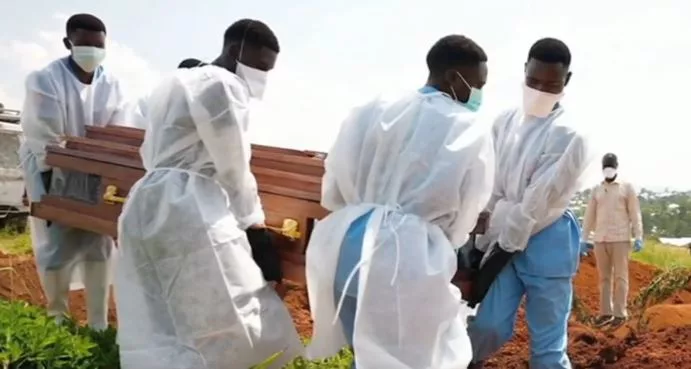
Kenya’s first confirmed Ebola patient has been buried at Lang’ata Cemetery in Nairobi under stringent health measures designed to prevent further transmission of the deadly virus.
The vehicle carrying the deceased arrived at the cemetery at about 2.30pm on Wednesday, with only a small group of mourners present at the Islamic section where the burial took place.
The mourners wore masks and maintained a safe distance from the grave as Ministry of Health officials supervised the burial.
A fire was lit next to the freshly dug grave as part of the procedure, with materials that had come into contact with the body destroyed at the site to minimise the risk of infection.
A health worker dressed in a full hazmat suit, including protective boots, was also seen disinfecting a red Toyota Fielder parked near the burial site.
The vehicle had transported the deceased from Jomo Kenyatta International Airport to Nairobi Hospital. The worker thoroughly sprayed the interior with disinfectant before leaving the cemetery.
How Ebola bodies are handled after death
A Ministry of Health official, who spoke on condition of anonymity, said strict safety measures begin immediately after the death of an Ebola patient.
According to the official, the body must be buried within 24 hours.
A trained Ministry of Health official first cleans and disinfects the body before wrapping it in several layers of protective material. Family members are not allowed to handle the body, and there is no viewing.
The deceased is then transported directly to the burial site, with only the body and driver allowed inside the vehicle.
At the cemetery, a limited number of relatives may be allowed to witness the burial, although they must remain at a safe distance as the body is lowered into the grave.
The grave must be at least six feet deep. After the burial, protective equipment and other materials used during the exercise, including hazmat suits and gumboots, are destroyed at the site.
Tight security at Lang’ata Cemetery
Security was heightened around the cemetery during the burial, with several men who attempted to document the proceedings removed from the area.
The extensive precautions offered a rare glimpse into the measures being implemented by health authorities following Kenya’s first confirmed Ebola case and death.