It is mid-morning at bushy Marapu village in lower Sagalla in Voi sub-county.
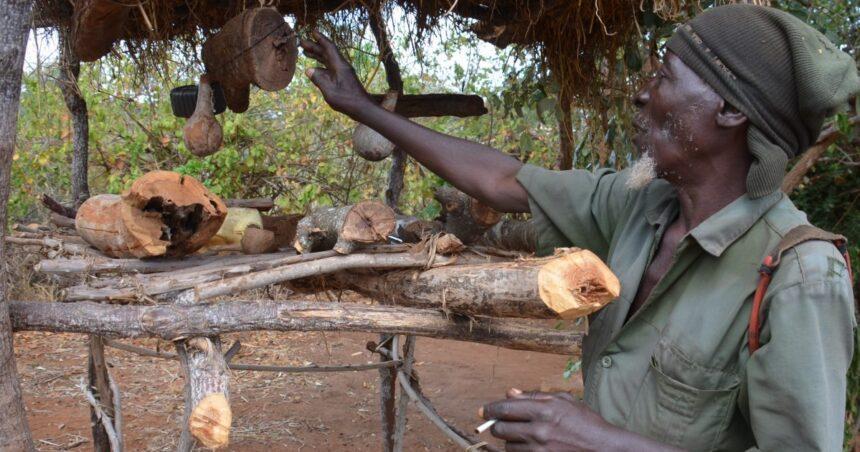
The old farmer inspects a tiny log hive dangling from a thatch-roofed makeshift shelter outside his hut. The contact sends a swarm of tiny insects flying whirling madly around his head.
Unbothered, he inspects the hive for cracks. He finds none. He replaces the hive. The frenzy ebbs. The swarm settles back save for a few curious insects still buzzing around the narrow wax-coated entrance.
“They don’t like disturbance but I have to check if the hive is intact,” says Mr. Julius Mwarangu as he moves to the next hive.


At 65, Mwarangu admits inspecting his hives is a ritual he has come to love. It keeps him connected to the bygone halcyon days when massive swarms of stingless bees fondly known to the locals as ‘Mbuche’ thrived in the wild bushes all over the Sagalla region.
He recalls that stingless bees were a crucial part of the Sagalla community. Honey from mbuche nourished herders while they grazed in the plains.
Women on firewood-collecting trips in the forest harvested honey for sweetening food while traditional medicine men used it to augment traditional healing herbs for the treatment of various ailments.
“The stingless bees have been a part of the community for as long as we can remember. Those days are now gone,” he says.
Currently, the stingless swarms have all but disappeared. In the region, stingless bees are only found in areas with dense bushes and zones where trees have escaped the wrath of charcoal burners. Even then, the surviving swarms are relatively small compared to those in the past.
“The land has changed. Mbuche are disappearing,” he explains. The nostalgic note in his voice is hard to miss.
Environmentalists say this disappearance is attributed to a number of factors. They include climate change, wanton cutting down of indigenous trees, prolonged drought and excessive use of herbicides on farms.
The invasion of illegal camels that browse on vegetation whose flowers provide fodder for the bees has also been blamed for the decline.
Mr. Charles Kuria, County Forest conservator with Kenya Forest Services (KFS) says apart from using chemicals in farms, the increase in forest fires during dry seasons has contributed to the loss of swarms.
“Heavy use of chemicals on farms aside, the frequent fires that ravage forests and bushes contribute significantly to the decline of these pollinators,” says the official.
However, an ambitious project Kishamba Community Improvement Organization (KCIO), a local conservation Community Based Organization, and International Center for Insects Physiology and Ecology (ICIPE) are expected to halt the decline in the population of stingless bees.
The project has introduced farmers to meliponiculture; stingless beekeeping, in a bid to shore up the stingless bees population and boost the domestic income through sale of honey from the activity.
For the last two years, the two organizations have worked closely with artisanal farmers in several rural villages in the county to promote the farming of stingless bees as a commercial activity. This is primarily to diversify domestic incomes and bolster local food production through targeted pollination initiatives in farms.

Already, over sixty farmers and selected youth groups are engaged in this activity across several villages in the project area. These villages include Bura and Rong’e in Mwatate; Werugha in Wundanyi and Sagalla in Voi sub-county.
Mr. Eric Mwanzi, an entomologist with ICIPE, says local farmers are embracing stingless beekeeping as they receive proper support and training.
The stingless beekeeping training entails hive management, hive hygiene, swarm separation, brood care and safe honey harvesting methods.
In addition to training, ICIPE is distributing modern beehives and other support structures to farmers who venture into stingless beekeeping an optimum environment needed for stability and swarm regeneration. “Farmers are gradually taking into this activity. The modern stands and hives we are giving will enhance productivity,” he explained.
Preserving the stingless bee population is also key to bolstering farm production in areas with high agricultural productivity. Mr. Mwazi says stingless bees are amongst the most efficient pollinators for agriculture in a controlled environment.
Stingless bees make honey with chemicals that ward off microbial and fungal growth, an adaptation to keep the substance from spoiling in the tropics. Given the wide variety of plant biodiversity in Voi, and the incredible range of botanical chemicals the bees mix into their honeys and wax, it’s also no surprise it has medicinal value. Indeed, some call such honey a “miracle liquid.”
Mr. Gibran Mwakai, the chair of KCIO, says his group is educating local farmers on the importance of conservation. He notes that indigenous trees that provide rich nourishment for stingless bees are harvested excessively to the verge of extinction due to their medicinal value.
The trees, he says, contain herbal remedies to treat ailments like respiratory infections and flu. “Local residents harvest the trees for their medicinal value. These trees provide valuable food for the stingless bees,” he explained.
Among the indigenous trees include Ganjahika (Medicinal tree), Mlasina (Sausage tree), and Mremavula (Marula tree) amongst others.
Francis Shingira, a young farmer in Marapu, says that youth groups in the village have taken up the call to urge residents to spare the indigenous trees and rear stingless bees. He adds that potential returns from sale of honey was encouraging, urging young people to take up the farming of stingless bees.
“The bees are easy to rear and they can co-exist together alongside other domestic animals,” he says.
There are expectations that ICIPE will extend this activity to zones outside the project area to encourage more people to participate in stingless bees farming