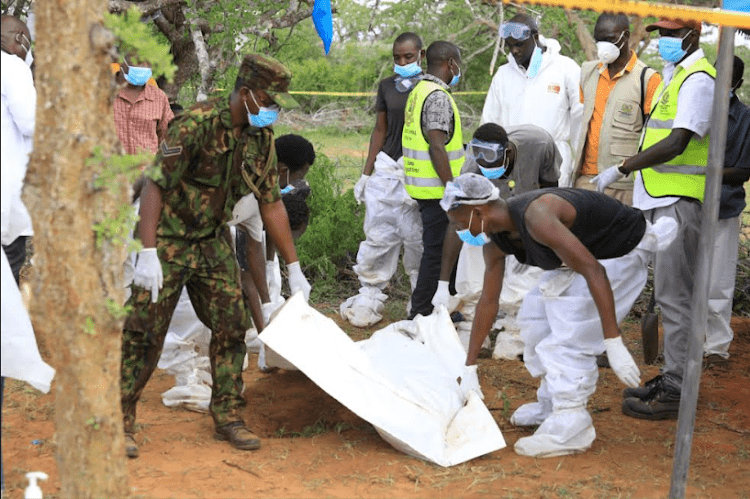
More than 200 people in Kenya – among them children – have been found dead close to a small village in the south-east of the country. Most of the deceased were reportedly followers of pastor Paul Nthenge Mackenzie. While starvation appears to be the main cause of death, some of the victims were strangled, beaten or suffocated, according to the chief government pathologist.
Fathima Azmiya Badurdeen, who has studied the drivers of religious extremism, particularly among violent extremist groups in the east African region, talks to The Conversation Africa’s Julius Maina about the cults and religious extremism challenges in Kenya where freedom of religion or belief is protected by the constitution.
What do we know so far about the cult deaths in Kenya?
No fewer than 200 men, women and children are known to have died after a Kenyan charismatic church pastor encouraged his followers to fast to death to “meet Jesus” in the afterlife. Bodies of the dead were recovered from numerous mass graves on a farm at Shakahola, a village on Kenya’s south-east coast, where Pastor Paul Mackenzie had his Good News International Church. Autopsies revealed that most had starved to death. But a small number, some children, had been strangled or suffocated to death.
Mackenzie now faces charges over the deaths. The victims came from all corners of the country, drawn to a man whose controversial teachings had come under government scrutiny as far back as 2017. Mackenzie’s apocalyptic narratives focused on the end of times, and were against the modern or western ways of life such as seeking medical services, education or music. His conspiracy theories emphasised the Catholic Church, the US and the United Nations as “agents of Satan”.
His other brush with the law came in 2019, when he faced counts of incitement to disobedience of the law and distributing unauthorised films to the public.
That same year, he closed the church, sold his TV station and moved to a ranch in a forested area of Kilifi county, where hundreds of families built houses. The church and TV station were sold to Ezekiel Odero, another televangelist. Odero is well known for his so-called miracle healing crusades, which draw tens of thousands. He is also under investigation for offences associated with the Shakahola mass suicide.
Religious extremism or religious movements with a cultic flavour are not new in Kenya.
How will this change the way religious extremism is viewed in Kenya?
New religious movements or individual preachers in Kenya rarely attract public scrutiny. There is also little public awareness of the social impact of such groups. Public debates in Kenya are more likely to focus on the occult – with “devil worship” as the popular catchphrase.
As far as religious extremism is concerned, Kenya’s focus has been on Islamic extremism, including what constitutes “terrorism”. These are highly politicised debates.
The president’s description of the Shakahola incident as “akin to terrorism” opens up a new epoch in which Kenyans can begin to look at all religions as potential incubators of extremism. Preventive measures can therefore be designed to address not just Islamist extremism but all forms of religious extremism.
In what ways is the cult similar to violent extremism?
I would place the Shakahola cult deaths within the narrow confines of cultism and religiously inspired violent extremism. A cult is a group of people inspired – or brainwashed – by a charismatic leader to follow extreme religious beliefs or practices at any cost to themselves. Such beliefs and practices rarely resemble those of established faiths or groups.
This is very close to violent extremist groups such as Al-Shabaab or Daesh who follow rigid religious value systems and beliefs. Such groups may differ in their justification for using violence to achieve political, ideological or social change. But both religiously inspired cults and extremist groups do tend to reimagine or reinterpret traditional scripture.
Both cults and violent extremist movements have similar push and pull factors at the individual level. In the cult death case, followers came from all over Kenya to seek out Mackenzie. Many of those individuals and families abandoned all their comforts to join his church in a remote location without basic amenities. Recruits to extremist networks such as Al-Shabaab show similar tendencies. They pledge to give up their earthly comforts for a higher calling in the name of misinterpreted or imaginary versions of religious texts.
In each case, the victims are exposed to mind control by charismatic religious preachers. The only difference is in the mode and motive for death in the name of the chosen cause. In Shakahola, it was massive casualties through starvation. The alternative might be suicide bombings aimed mainly at political objectives.
How have Kenya’s constitutional freedoms been misused by religious extremists?
Freedom of religion or belief is guaranteed by the Kenyan constitution:
Every person has the right to freedom of conscience, religion, thought, belief, and opinion.
The question that confronts Kenya is whether “fasting to death” falls within the constitutional rights to freedom of religion. How does this sit with the right to life in the constitution?
What needs to be done to prevent this from happening again?
In Kenya, countermeasures dealing with Islamist extremism have shown us that religious institutions and activities can be scrutinised and regulated to prevent extremism and terrorism.
These can be extended to religious cultism without infringing the constitutional right to freedom of religion or belief. Kenya needs an honest discussion about how regulations can safeguard the right, to prevent fake religious leaders from misusing it.
President Ruto has commissioned a team to investigate the Shakahola deaths. The team has the broader mandate of developing a legal framework for scrutiny and self-regulation of religious institutions. This is a complex task. What we can learn from Kenya’s previous attempts to curb religious radicalisation is that public participation is key in designing and putting legal frameworks to action.
This article was first published by ‘The Conversation’ on May 9, 2023. You can read the original article here.