In a groundbreaking development, civil servants are set to experience a substantial increase in their salaries, ranging from an impressive 7% to a remarkable 10%.
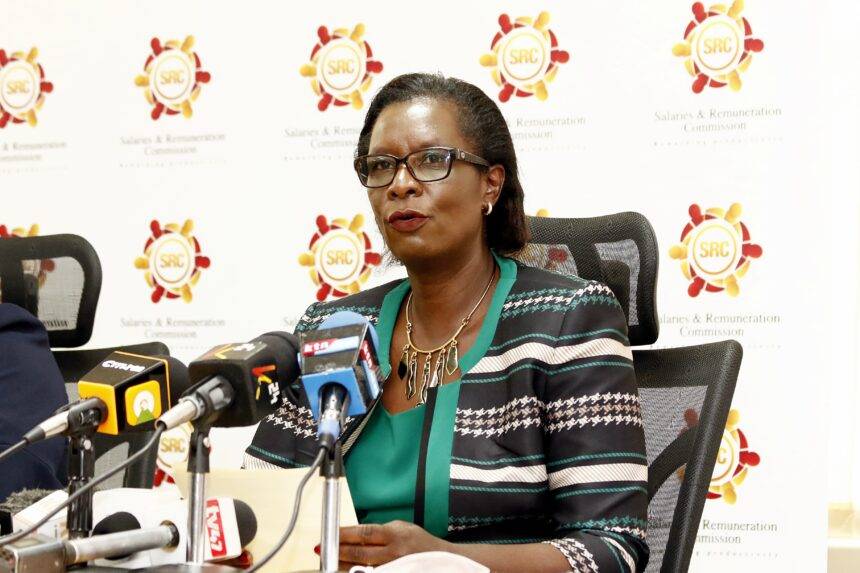
The announcement was made by Lyn Mengich, the Chairperson of the Salaries and Remuneration Commission (SRC), on Wednesday, August 9.
Mengich disclosed that the National Treasury has allocated a substantial budget of Ksh21.7 billion for civil servants for the fiscal year 2023/24. This, she said, is in alignment with the constitutional principles of fiscal responsibility and affordability.
These salary adjustments, set to be retroactively implemented from July 1. The adjustments come as part of an initiative aimed at enhancing financial stability for civil servants.
Who will benefit from the increase?
This increase in salaries will notably impact various sectors of the public workforce, including educators, medical professionals, law enforcement personnel, military personnel, and executive staff members.
The adjustments will be distributed based on job roles and sectors.
The Executive sector was allocated Ksh126 million, making up 0.6% of the overall budget for these increments.
Key figures within Parliament will receive a Ksh78 million allocation, equivalent to 0.4% of the total allocation. The Judiciary’s state officers will be granted Ksh305 million, accounting for 1.4% of the distribution.
Similarly, county state officers will receive Ksh408 million, constituting 1.9% of the allocation.
Teachers, an integral part of the civil service, will benefit from a substantial allocation of Ksh9.5 billion. The allocation to the teachers forms 44.2% of the overall budget. The broader civil service sector will also receive Ksh1.8 billion, amounting to 8.5%.
Mengich emphasized that these adjustments come as the government endeavors to bolster staffing levels in crucial areas such as health, education, teaching, and security. The move aims to address the current imbalances in teacher-student ratios, healthcare provisions, and security personnel relative to the population.
“But we are yet to achieve the desired ratios for teachers to students, healthcare and security to population ratios. Those are the areas we will continue to recruit,” Mengich explained.

Impact on government wage bill
The implementation of these increments also involved a comprehensive evaluation by the SRC of the wage bill’s relationship to the Gross Domestic Product (GDP) and government revenue.
“However, we must watch the wage bill ratio to revenue and GDP,” Mengich added.
In light of this, Kenya’s GDP, currently standing at Ksh15 trillion, was carefully considered, with the country’s ratio to GDP noted to be on track at 7.4%. However, projections foresee this figure slightly decreasing to 7.19% within the year.
“We are on target in comparison to developing countries,” Mengich said.
Mengich clarified that the Public Finance Management Act 2012 dictates that 35% of revenue must be allocated to the wage bill. Encouragingly, this goal is being realized, with the ratio projected to decrease from 47.06% in 2022 to an anticipated 40.5% in 2023.
To sustainably manage the wage bill, the SRC is planning an array of measures. These encompass aligning GDP and revenue growth to outpace wage bill growth, a strategy intended to ensure financial stability. The commission will also scrutinize, establish, and advise on remuneration and benefits, all within the framework of fiscal prudence.
Additionally, the commission has already recommended the elimination of four allowances granted to civil servants.
These include retreat allowances, taskforce allowances, sitting allowances for institutional internal committee members, and daily subsistence allowances.
Lastly, the SRC will actively promote productivity within the public service. This process will also include efforts to curb phantom employees and enhance employee evaluations.