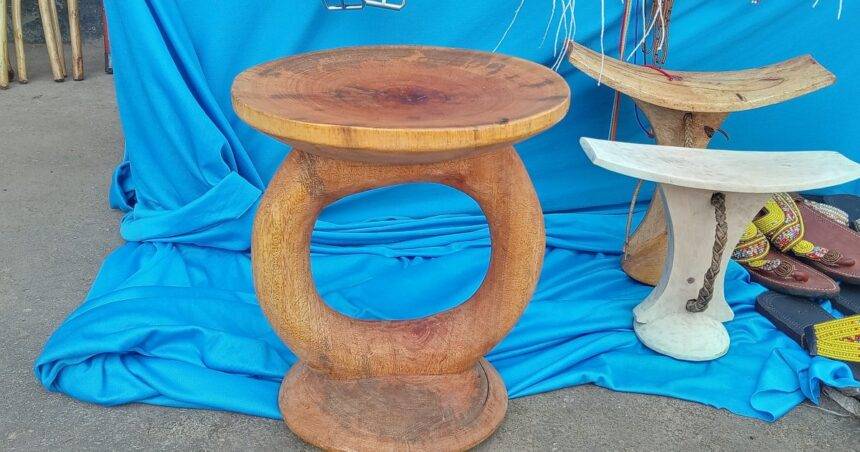
In the Pokot community, a unique cultural tradition persists, defying the usual etiquette of relying on provided seating at events.
Regardless of seating arrangements, adult men carry their own special stools, especially in remote pastoralist areas.
These traditional stools, known as “Ng’achara,” hold significant cultural importance as symbols of elderhood, power, leadership, and respect among the Pokot people.
Mzee John Muok, former Paramount Chief and current chairman of the Pokot Council of Elders, explains that these stools were originally created to address the needs of herders in dry regions, where pastoralism is a primary livelihood.
The stools were designed to protect against dangerous insects while tending to livestock far from their homesteads.
The Ng’achara stools serve dual purposes: mobility and comfort. They accompany the elders wherever they go, even if chairs are provided at their destination. Different designs exist, some serving as both seats and pillows.
Interestingly, this cultural practice is also shared with the Turkana community, who call the stool “Charadum.”
Both communities use specific indigenous hardwood trees for crafting the stools, with skilled specialists undertaking this task.
The stools’ designs may vary for aesthetic reasons but hold no hidden significance.
Only men are allowed to use these stools, as it’s considered taboo for women to sit on them. The stools are exclusively owned by elders aged 55 and older.
Upon an elder’s passing, the stool may be inherited by friends, brothers, or neighbors during the anniversary day when the elder’s possessions are distributed.
However, the deceased elder’s children are exempt from inheriting the stool.
The COVID-19 pandemic highlighted the stools’ practicality, as they helped maintain social distancing during gatherings.
Elders, who often sit separately from the younger generation, utilized their personal stools.
Moreover, elders typically carry “Rungus,” symbolic of their power, respect, and leadership. Unlike the stools, which are exclusive to elders, walking sticks have broader utility.
These traditional stools hold great honor and are gifted to visiting leaders and elders.
The practice of gifting these stools signifies respect and courtesy.
Today, these stools are also sold as decorative items for homes, reflecting their enduring cultural significance.