During his address at the African Climate Summit held on Tuesday, September 5, at the Kenyatta International Convention Centre (KICC) in Nairobi, COP28 President-designate Sultan Al Jaber announced that this funding would be channeled into supporting clean energy initiatives in Africa.
However, Al Jaber emphasized that only countries with clearly defined, long-term transition plans and investment strategies would be eligible to benefit from this financial support.
He stressed that these investment plans must be accompanied by robust policies and regulatory frameworks, with a strong focus on priority areas such as renewable energy, in order to effectively address the long-term consequences of environmental pollution.
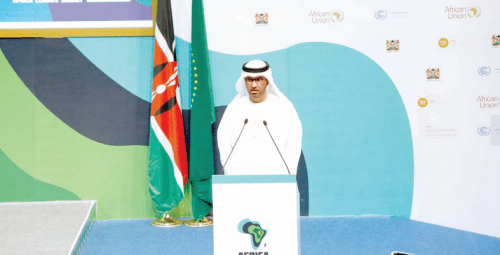
Al Jaber also highlighted the United Nations Framework Convention on Climate Change (UNFCCC) working plan, which was established following the 2015 Paris Agreement. He expressed widespread anticipation that the Stocktake, a comprehensive assessment, would likely find that the world is deviating from its outlined objectives as set in 2015.
Africa’s energy infrastructure
Furthermore, Al Jaber urged African Heads of State, including President William Ruto, to modernize their basic energy infrastructure and streamline development processes. This would help eliminate bureaucratic obstacles that have been impeding market access and progress on the continent.
“This initiative builds on the UAE’s track record of commercially driven, innovative blended finance solutions that can be deployed to promote the adoption of clean energy in emerging and developing nations. This multi-stakeholder partnership approach is designed to accelerate sustainable economic progress, address the challenge of climate change, and stimulate low carbon growth,” he stated.
Al Jaber emphasized that Sub-Saharan Africa’s development has been hindered by a lack of sustainable energy sources, highlighting that approximately 600 million people in the region still lack access to electricity.
The COP28 President-Designate affirmed that the UAE Finance Initiative’s primary objective is to collaborate with African nations to provide reliable access to clean energy, thereby driving social and economic development.
He also noted that, currently, investments in African renewables account for only 2 percent of the global total and fall short of the approximately US$60 billion annually needed on the continent by 2030 to support sustainable energy initiatives.