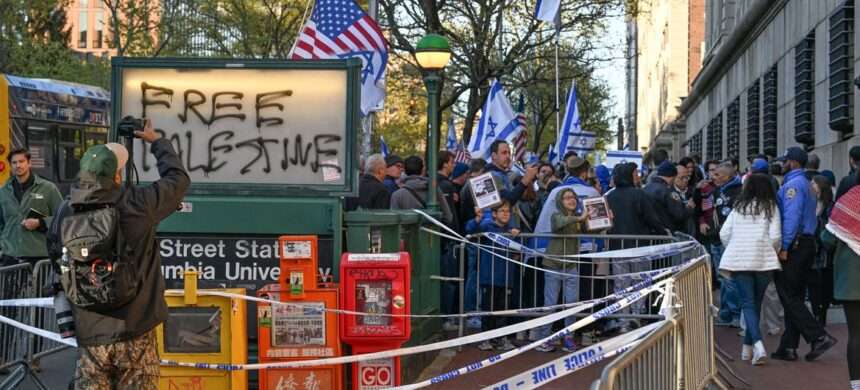
Over 1,000 pro-Palestinian protesters have been arrested in recent days according to U.S. media reports, as the anti-war demonstrations at over 20 American universities continued on Tuesday.
Some schools including Columbia University, where the protests initially erupted, have seen a further intensification of the protests, while on some other campuses, the situation appears to be cooling down.
Early Tuesday, dozens of protesters at Columbia University’s Manhattan campus moved furniture and metal barricades to block the entrance of Hamilton Hall, one of several buildings occupied by students during the 1968 civil rights and anti-Vietnam War protests.
Protesters formed a human chain in front of the building and said that they would only leave unless the school meets their demands, which include the university’s divestment from Israeli-related companies, disclosure of all financial assets, and amnesty for students and faculty disciplined in the protests.
In a statement Tuesday, a Columbia spokesperson said that “students occupying the building face expulsion.”
The university spokesperson stated that the protesters were offered an opportunity to depart peacefully and complete the semester. However, those who does not comply with the conditions outlined since Monday should face suspension.
“Protesters have chosen to escalate to an untenable situation — vandalizing property, breaking doors and windows, and blockading entrances — and we are following through with the consequences we outlined yesterday,” the spokesperson said.
On Tuesday night, New York police entered Columbia University campus and started to make arrests after pro-Palestinian protesters refused to leave.
In light of the escalation, the White House expressed disapproval of the actions taken by the protesters at Columbia University.
“The president believes that forcibly taking over a building on campus is absolutely the wrong approach, that is not an example of peaceful protests,” White House national security communications adviser John Kirby told reporters. “Taking over a building by force is unacceptable.”
“A small percentage of students shouldn’t be able to disrupt the academic experience, the legitimate study, for the rest of the student body,” Kirby said.
At a demonstration at the University of North Carolina at Chapel Hill earlier Tuesday, police entered the protest camp and arrested about 30 people.
Later in the day, protesters returned to the site and replaced the American flag in the center of the campus with a Palestinian flag. They linked arms and formed a circle around the flagpole, and could be heard chanting “Intifada” and “Free Palestine,” according to the school newspaper. Law enforcement officers later switched back to the American flag.
In the northwestern state of Oregon, protesters occupied a library at Portland State University overnight. On Tuesday, the university urged protesters to leave the library and asked the police for help.
Clashes between police and protesters turned violent in some cases. Police used riot gear and pepper spray to break up a protest at Virginia Commonwealth University in Richmond late Monday after protesters threw objects at officers and used chemical spray, officials said. Thirteen people, including six students, have been charged with unlawful assembly and trespassing.
Since protests broke out at Columbia University on April 18, more than 1,000 protesters have been arrested on over 20 U.S. college campuses in recent days, the New York Times reported.
In the northwestern state of Oregon, protesters occupied a library at Portland State University overnight. On Tuesday, the university urged protesters to leave the library and asked the police for help.
Clashes between police and protesters turned violent in some cases. Police used riot gear and pepper spray to break up a protest at Virginia Commonwealth University in Richmond late Monday after protesters threw objects at officers and used chemical spray, officials said. Thirteen people, including six students, have been charged with unlawful assembly and trespassing.
Since protests broke out at Columbia University on April 18, more than 1,000 protesters have been arrested on over 20 U.S. college campuses in recent days, the New York Times reported.