
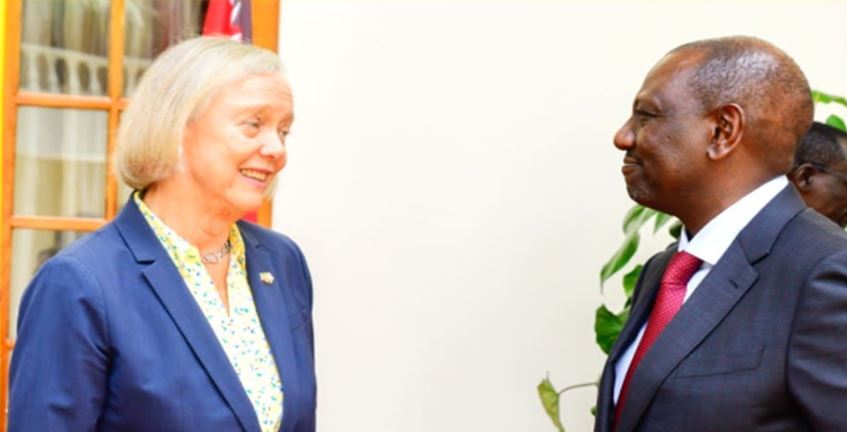
The training for the health promoters drawn across the counties will be funded through USAID’s Kenya Health Sector Support Program (KHSSP).
The aim of the training is to equip the CHPs with knowledge in various health-related areas, including communicable and non-communicable diseases, maternal and child health, nutrition, sexual and reproductive health, and HIV/AIDS care. The training will be conducted through a combination of classroom instruction, hands-on training, and mentorship. The CHPs will also be provided with toolkits and resources to support their roles.
President Ruto emphasized the importance of preventive healthcare in saving lives and resources. He highlighted that the trained CHPs will be equipped with modern medical equipment and deployed in communities across Kenya to deliver preventive care, screen for diseases, and connect patients to treatment services.
The collaboration between USAID and Kenya aims to improve the health of Kenyans by increasing access to quality healthcare. President Ruto commended USAID for its innovative initiatives, such as the M-Mama mobile app ambulance service, which provides emergency transport for pregnant women and new mothers in distress. The service has been successful in reducing maternal mortality and improving maternal care in rural areas.
“Kenya and USAID have a robust partnership across many sectors and particularly in healthcare,” President Ruto stated.
The training of Community Health Promoters is seen as a significant development in Kenya’s health sector, strengthening the healthcare system and improving the overall health of residents. President Ruto expressed gratitude to USAID for their partnership and praised the agency’s administrator, Samantha Power, for her leadership.
M-Mama, the joint initiative between USAID, the Vodafone Foundation, and the governments of Kenya, Tanzania, and Lesotho, will also be integrated into the training. This innovative service provides a toll-free number for women experiencing maternal emergencies, allowing them to request assistance. A health worker records their information and dispatches a taxi to transport them to the nearest hospital. The service has been successful in saving lives and improving the quality of maternal care in rural areas.
Overall, the collaboration between Kenya and USAID aims to enhance healthcare provision, reduce maternal mortality, and improve health outcomes for Kenyans, particularly in remote areas.
Community Health Strategy in Kenya
The community health strategy is one of the approaches the government of Kenya has adopted in its quest to achieve Vision 2030 and also provide the right to health for all Kenyans, as guaranteed in the Constitution. The importance of community health services (CHS) has since been restated in the Kenya Health Policy Framework 2013-2030, as well as in the Kenya Health Strategic and Investment Plan 2014-2018.
To achieve this strategy, the government engages the services of community health promoters, also known as public health practitioners, whose major role is to help inform the public of certain medical issues and educate them on how to react appropriately. Much of the job revolves around social skills, such as community outreach or conducting public studies

