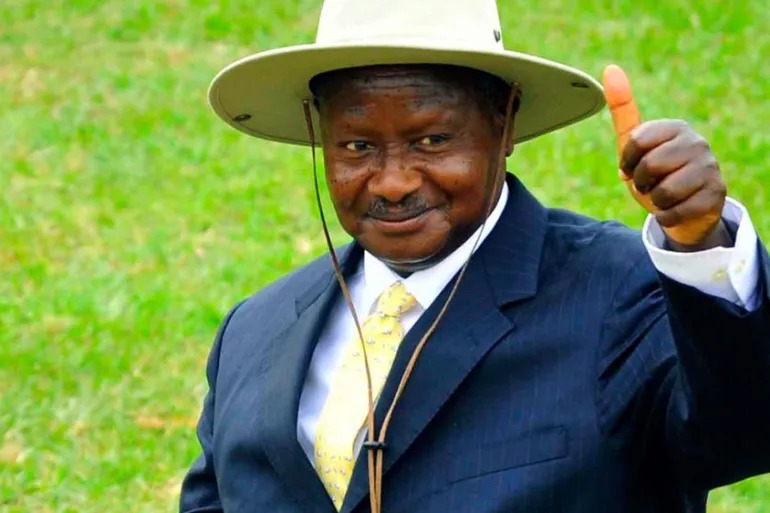
President Yoweri Museveni of Uganda has announced that he is no longer infected with Covid-19. After testing positive, the president underwent a period of recuperative leave “to focus on his treatment and recovery”.
His disclosure of his Covid status on June 7, 2023, sparked widespread debate and speculation across East Africa, as it was the first time in many years that he had been noticeably absent from the public eye since taking over power on 26 January 1986.
In a lengthy and wry statement published on Twitter, Museveni referred to himself as a “veteran graduate of the war with that enemy”, and encouraged Ugandans to adopt his health strategy, which includes avoiding risk factors such as smoking and alcohol, engaging in exercise, and consuming healthy African food.
“On the war with Corona, it is now confirmed that I am a veteran graduate of the war with that enemy. Today, the samples showed that I had turned negative vis a vis corona. Even the samples from last Wednesday had shown the reduced presence of the virus parts. The Glory goes to God,” said Mr. Museveni.
The president in 2022 was on record challenging Ugandans and Africans at large to stick to traditional and organic food in the wake of the food crisis caused by the global dynamics.
“Recently, when the Europeans started fighting amongst themselves, people started crying for food. I said if you know, there is no bread from Ukraine, why don’t you eat Muhogo as I do. They laughed at me, saying we modern people eat bread,” said Museveni.
End of Covid-19 as global public health emergency of concern
Meanwhile, although the World Health Organization (WHO) has declared the end of Covid-19 as a public health emergency, the disease still poses a global health threat.
The COVID-19 pandemic is a global outbreak of coronavirus, an infectious disease caused by the severe acute respiratory syndrome coronavirus 2 (SARS-CoV-2) virus.
The first cases of novel coronavirus (nCoV) were first detected in China in December 2019, with the virus spreading rapidly to other countries across the world. This led WHO to declare a Public Health Emergency of International Concern (PHEIC) on 30 January 2020, and to characterize the outbreak as a pandemic on 11 March 2020.
On May 5, 2023, the WHO Emergency Committee on Covid-19 recommended to the Director-General that the disease no longer met the criteria of a PHEIC due to its established and ongoing nature. The WHO however emphasized that declaring an end to the public health emergency does not mean that the disease is no longer a global threat.
Despite this declaration, the WHO African Region (AFRO) has reported a total of 8,992,074 laboratory-confirmed COVID-19 cases, with 174,263 related deaths as of 3 May 2023. Specifically, the Ministry of health in Uganda has reported 170,647 confirmed COVID-19 cases with 3,632 deaths in the same period.
Since the beginning of the pandemic, over 2 million people in the European Region have lost their lives to the disease, while in Kenya, the cumulative death toll stands at 5,689 cases.