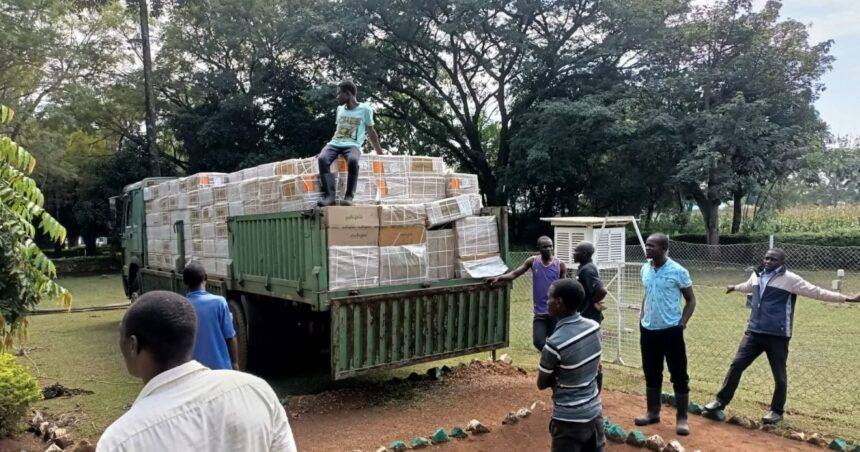
The cotton farming sector in Busia has received a significant uplift as the National Cereals and Produce Board (NCPB) granted approval for farmers to collect subsidised fertilizer and cotton seeds in preparation for the upcoming planting season.
Highlighting Busia County as a prime example for cotton and edible oil cultivation, Statehouse Spokesperson Hussein Mohamed underscored the area’s strategic importance.
The allocation of 82,000 bags of subsidized fertilizer and 17 tonnes of cotton seed will be distributed to farmers already registered within various cotton cooperatives across Busia’s seven sub-counties. This initiative serves as a pilot program to revitalize the cotton industry, with the government striving to boost cotton production from the current 300 kg per acre to a minimum of 800 kg.
Busia’s objective is to extend its total cotton cultivation area from 11,253 acres to 42,000 acres, aiming to rejuvenate the cotton ginnery at Muluanda.
Esther Chege, the Western Region Manager of the National Cereals and Produce Board, communicated in a circular that the allocation of cotton seed per ward was based on available quantities.
As per the circular, farmers registered under various cooperative societies will collect their fertilizers and cotton seed from specific collection points, such as the Mulwanda Cooperative Society warehouse or the NIA warehouse in Bunyala Sub County.
Samia, Bunyala, and Matayos sub-counties are poised to receive 1,424 kilograms of cotton seeds (C571 BGII cotton) and 1,899 bags of fertilizer each, with an allocation of 949 acres for each sub-county’s inaugural project.
Butula sub-county, distinct from the others, will receive 1,424 kilograms of cotton seed of the C569 variety and 1,899 bags of subsidized fertilizers.
In Teso North, the Jairos Cotton Farmers Cooperative Society will distribute 1,899 bags of fertilizers and 1,424 kg of cotton seed, featuring two cotton seed varieties – the fast-maturing C571 (765KG) and MAHYCO C567 (659KG), with respective acreage for each.
Similarly, in Teso South, the Adungosi Cotton Farmers Cooperative Society and Lukolis Cotton Farmers Cooperative will provide members with MAHYCO C567 and C569 cotton varieties. Fertilizers and seeds will be available at specific collection points.
Nambale farmers will collect fertilizer and planting materials at designated warehouses after being listed in their respective wards, supported by specific cooperative societies.
The enthusiastic adoption of cotton farming is evident, with over 12,000 Kenyans already registered in cotton cooperatives, according to NCPB.