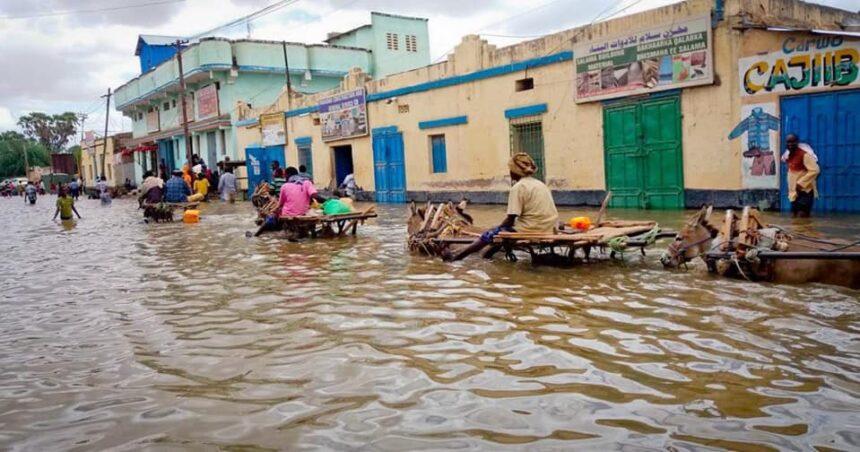
The Kenya Meteorological Department has issued a stark warning, forecasting an imminent resurgence of El Niño this year with a staggering 99% likelihood of widespread heavy rainfall across various regions of the country.
El Niño, characterized by abnormally elevated warming of the central and eastern tropical Pacific Ocean’s surface, accompanied by weakened eastward winds, is set to make its presence felt.
This cyclic phenomenon, which emerges approximately every 3 to 5 years, historically leads to excessive precipitation and flooding within the East Africa region.
In an official address to the press in Nairobi, meteorologists explained that intense and sustained rainfall is anticipated in multiple areas, including the Lake Victoria Basin region, Kisii, Elgeyo Mrakwet, Bungoma, Trans Nzoia, West Pokot, Vihiga, Laikipia, Nakuru, and Narok counties.
The rainy season is predicted to commence in September and persist until January, with its zenith expected in October.
In the north-western counties encompassing Turkana, Marsabit, and Samburu, intermittent rainfalls surpassing the long-term average for the season are projected.
“For the highlands east of the Rift Valley, including Nairobi, we anticipate above-average rainfall throughout the season, evenly distributed across space,” highlighted the department.
The lowlands should brace for rainfall surpassing the long-term average, while in the north-eastern counties, sporadic precipitation slightly exceeding the seasonal norm is anticipated. The highest rainfall is anticipated in Wajir and Mandera counties.
The weather experts further pinpointed potential flood-prone zones, identifying Nyakach, Nyando, lower sections of the Nzoia River, Winam Gulf, and the lower areas of the Sondu River in Western Kenya as particularly susceptible.
Flood risks are also anticipated in the Rift Valley region, including Gilgil, Narok town, and Suswa, as well as in coastal towns such as Mwatate, Tana River delta, and Mwatate.
Additionally, flooding is likely in Lodwar and Lokichar in north-eastern Kenya, spurred by the abundance of seasonal rivers.
Major urban centers, including Nairobi, Naivasha, Nakuru, and Mombasa, could also experience flash floods.
Moreover, Kenyans have been cautioned about the looming threat of landslides in regions characterized by waterlogged soils, spanning from West Pokot and Kericho to Elgeyo Marakwet, Mt Elgon, Narok, Nakuru, Baringo, Murang’a, and Kilungu areas in Makueni County.
It is noteworthy that El Niño’s resurgence follows a three-year La Niña phase, as warned by the Food and Agriculture Organization of the United Nations (FAO).
La Niña, characterized by cooling sea-surface temperatures across the east-central equatorial Pacific, has manifested in recent years with stronger east winds.
The East African region suffered the consequences of consecutive La Niña events, with failed crops and famine alerts striking multiple countries.
FAO officially declared the end of the 2023 La Niña event in March 2023.