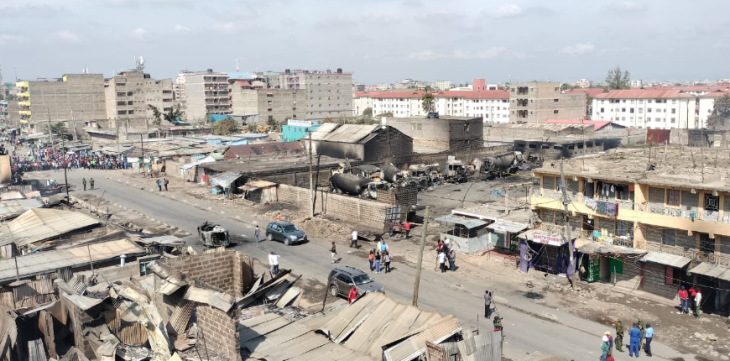
The Energy Petroleum Regulatory Authority (EPRA) has officially acknowledged that the gas filling station in Embakasi, Nairobi, where an explosion occurred on Thursday night, was operating without proper authorization.
EPRA stated that it had turned down multiple applications for construction permits for a Liquefied Petroleum Gas (LPG) storage and filling plant in the Mradi area of Embakasi, Nairobi County. The rejection was based on various factors, including the high population density in the vicinity.
In a released statement on Friday, EPRA disclosed that it had received applications on March 19, 2023, June 20, 2023, and July 31, 2023. However, the regulatory authority emphasized that it rejected all these applications due to their failure to meet the prescribed criteria for an LPG storage and filling plant in that specific area.
The primary reason for rejection, as outlined by EPRA, was the inability of the proposed designs to comply with the safety distances stipulated in the Kenyan Standard. EPRA further highlighted that the applicant had been instructed to submit a Qualitative Risk Assessment (QRA), clearly outlining the radiation blast profiles in the event of an explosion, considering the high population density around the proposed site.
EPRA explained, “The blast profiles are simulated by the use of computer software and indicate the effect of a typical blast in terms of heat radiation and tremor/vibration and are useful in reviewing the safety of the surrounding areas.”
According to EPRA, the applicant failed to provide the requested QRA, leading to the rejection of the applications.
As the regulatory body, EPRA declared that it has implemented short and medium-term measures to ensure the safety of all LPG plants in the country. This includes conducting detailed technical audits of all licensed LPG plants with the objective of ensuring a high safety integrity status in terms of Health, Safety, Security, and Environment (HSSE).
EPRA also emphasized that administrative actions are taken to revoke operating licenses for plants rated below the high safety integrity status. Additionally, surveillance and enforcement actions are carried out, including demolishing illegal plants operating across the country and addressing malpractices in the sector.