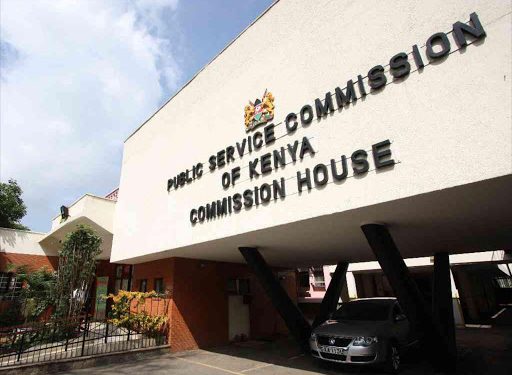
A report by the Public Service Commission (PSC) has highlighted disparities in ethnic representation within government ministries and State departments.
The report, tabled by PSC chairperson Anthony Muchiri, indicates that of the total 75,031 positions in government ministries and State departments, the Kikuyu community holds 22.25 % (16,691 slots), while the Kalenjin community holds 14 % (10,565 slots).
The Luhya community comes in third with 11.83 % (8,879 slots), followed by the Luo community with 10.36 % (7,774 slots). The Kamba community completes the top five with 9.16 % (6,874 slots).
On the converse, nine ethnic communities have been excluded from employment opportunities in the government since the implementation of the new Constitution over a decade ago.
The communities affected include Aweer/Waata, Dahalo, Gosha, Konso, Makonde, Nubi, Walwana/Malakote, Wayyu, and Kenyan-Americans. Mr. Muchiri noted that while some of these communities are represented in parastatals, they are notably absent from government ministries and State departments.
Additionally, the report sheds light on the overrepresentation of certain communities, particularly the Kikuyu and Kalenjin, in the public service.
In the financial year 2022/23, the report underscored the significant overrepresentation of the Kikuyu and Kalenjin communities, despite their populations representing 17.13 % and 13.37 % of the national population, respectively.
The Kikuyu community held 20.53 % of available public service jobs, while the Kalenjin community held 17.3 %.
The report also highlighted the disproportionate lack of representation of certain smaller ethnic communities, such as the Kenyan European and Hawiyah communities, who are not represented in employment in the public service.