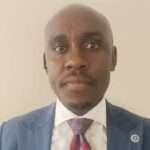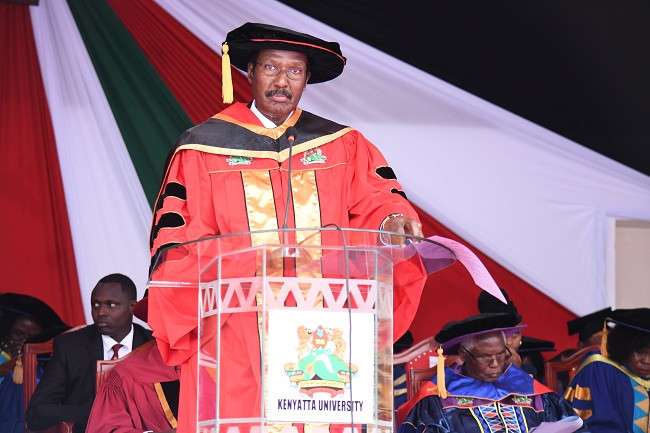
Dr. Ben Chumo has formally resigned as Chair of the Kenyatta University (KU) Council, stating that his decision was driven by principle amid what he describes as a compromised leadership process.
His resignation follows reports that he tendered it to Education Cabinet Secretary Dr. Julius Ogamba on Monday.
Why He Says He Quit
According to Dr. Chumo, his departure was not due to pressure from the Kenya Universities Staff Union (KUSU), as some sources have claimed.
“Contrary to claims, I did not resign because of union pressure — nothing could be further from the truth,” he told local media.
He added that throughout his career, including when he headed large organisations, he faced heavier pressure than he has ever seen from a union.
Dr. Chumo went on to suggest that some actors may be using the union’s voice to “push a narrative” not grounded in reality.
“Someone is using the union … to assign blame, perhaps even to make it look like they pushed me out,” he added
In his experience, he told reporters, no union ever forced him from a leadership role—not even when he was at Kenya Power and Lighting Company (KPLC), where he managed over 30,000 unionised workers.
He believes the real issue was interference in the recruitment of a new Vice-Chancellor (VC).
Dr. Chumo revealed that a call from senior officials in the Ministry of Education asking him to attend a council meeting was a clear signal that the ministry had lost faith in the board under his leadership.
“Ordinarily, the Ministry of Education only participates through concurrence, not by attending Council meetings … When a top figure in the ministry attends a meeting, the message is clear: the ministry has lost faith in the Council … If the ministry has no faith in me, then what purpose do I serve?” he asked.
He was particularly concerned that such ministry involvement compromised the integrity of the process.
“When you interfere with the process, the outcome becomes compromised. … When the ministry stepped into our Council room, that signalled the wrong start. That is why I chose to step aside.”
The Contested VC Recruitment
Dr. Chumo’s resignation comes amid a highly charged process to recruit a new Vice-Chancellor for Kenyatta University.
The current VC, Prof. Paul Wainaina, is expected to retire in late January 2026.
The delay in selecting his successor has drawn sharp criticism — including from KUSU, which has raised concerns about a lack of communication and transparency.
But Dr. Chumo insists there’s no delay. He pointed out that Wainaina’s retirement date gives ample time to recruit properly.
“It would have been ideal for the outgoing VC to hand over to the incoming one, but there is no rush to stampede the process,” he said.
The tug-of-war over this appointment has also spilled into the courts.
A petition filed in the Employment and Labour Relations Court by Lawrence Omondi Chero seeks to bar Prof. Wainaina from influencing the selection of his successor, citing fears of bias.
According to Chero, the VC is leveraging his position to set criteria favorable to certain candidates.
Dr. Chumo, however, maintains that the recruitment power lies with the Council and the Public Service Commission (PSC) — not with the VC’s office.
Notably, Prof. Wainaina was recently reinstated after a court ruled his suspension and the recruitment process were irregular. The court also noted that his contract, which runs through January 2026, remains valid.
Calls for Change in University Governance
The controversy at Kenyatta University is not isolated.
Members of Parliament, including those on the Public Investments Committee on Governance and Education, have pushed for the KU Council to be dissolved and for Prof. Wainaina to be reinstated permanently.
Meanwhile, union leaders say Dr. Chumo’s exit should open the way for a more transparent and inclusive recruitment process.
KUSU has expressed optimism about a smoother leadership transition.
In his farewell remarks, Dr. Chumo said he is proud of what the Council achieved under his watch. He highlighted that during his tenure, KU admitted over 10,000 first-year students in a single academic year and now serves more than 72,000 students — making it one of Kenya’s largest public universities.
“We promoted the highest number of professors and staff because we believed that improving the people improves the institution,” he said.
He argued that his record is not one of a poor performer: “I have always delivered results.”