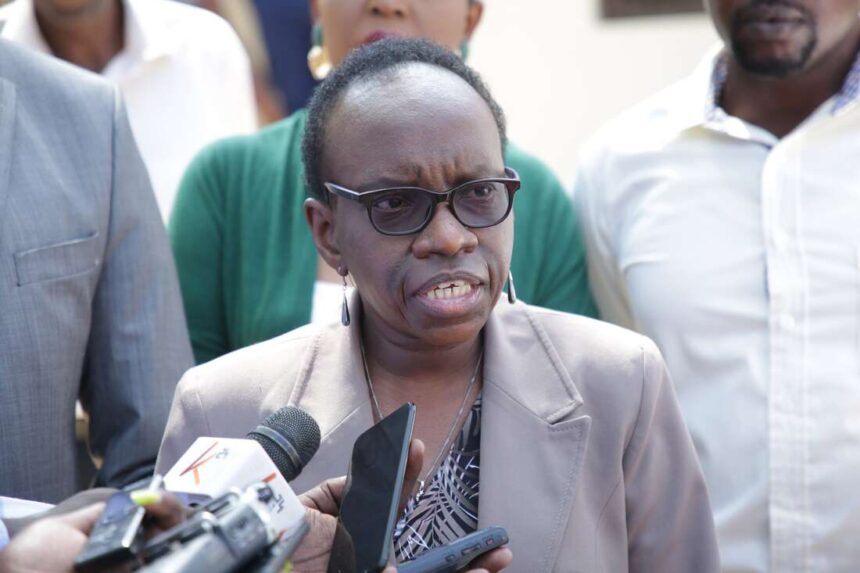
Auditor-General Nancy Gathungu has raised concern regarding a worrying trend of fund withdrawals by the Treasury without obtaining prior approval from the National Assembly.
The Auditor General also raised concern that the amounts have now reached a staggering Ksh 147.3 billion.
Gathungu highlighted a significant escalation in non-sanctioned withdrawals, as outlined in Article 223, from Ksh.1.1 billion requested during the 2014/2015 financial year to a staggering Ksh.147.3 billion requested by the President Ruto’s government in the 2022/2023 financial year.
This alarming increase represents a shocking surge of 13,000% over a span of nine years.
MDAs surpassing amounts approved by Treasury
Her remarks come in the wake of a Special Audit report revealing that five government Ministries, Departments, and Agencies (MDAs) had requested Ksh.5 billion for recurrent expenditure and an additional Ksh.2.8 billion for development expenditure.
Although these sums were approved by the Controller of Budget, they were not disclosed in the information submitted to the National Treasury.
Moreover, six MDAs incurred expenditures totaling Ksh.47.2 billion, surpassing the amount approved by the Treasury as additional funding granted under Kenyan law.
The report also highlighted instances where some MDAs exceeded the 10% threshold of the appropriated budget since 2014, contravening Section 43(2) of the Public Finance Management Act, 2012.
Ruto’s fertilizer subsidy program
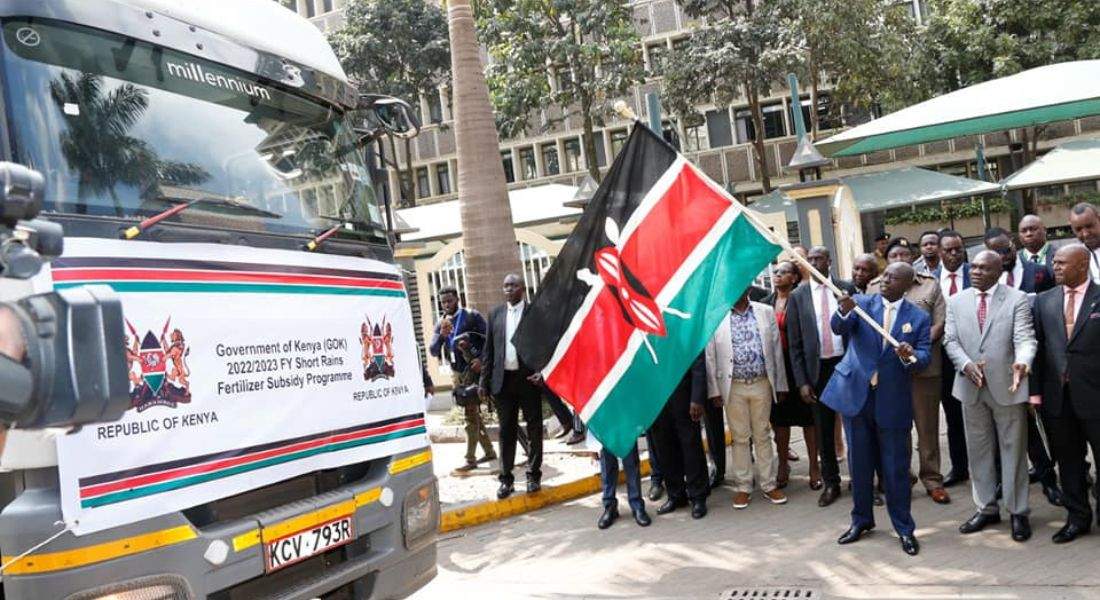
The Auditor-General also raised concerns about Ksh.7.4 billion approved by the Treasury for the Fertilizer E-Subsidy program in September 2022.
The fertilizer which was subsidized by the government was not distributed in time for the planting season hence was not effective.
“Although the fertilizer had been distributed to farmers, the program may not have achieved its intended objective as the distribution of the fertilizer was not timely for the planting season,” Gathungu noted.
Deficiencies in government’s acquisition of AFREXIM Bank shares
Gathungu further pointed out deficiencies in the National Treasury’s acquisition of shares during the 2022/2023 financial year.
Notably, uncertainty surrounds shares amounting to Ksh.6.3 billion obtained by the Government of Kenya in the Eastern and Southern African Trade and Development Bank, as well as the Africa Export-Import Bank (AFREXIM Bank).
“We have not received a response regarding our request on Eastern and Southern African Trade Development Bank shareholding to date. Consequently, we were unable to confirm the purchase of shares and determine whether there were any benefits accruing to the Government of Kenya,” said the Auditor General.
Distribution of relief food by government
Additionally, the Auditor General highlighted the allocation of Ksh.21 billion for the distribution of relief food from the financial year 2016 to 2022.
Several concerns were identified, including the absence of comprehensive guidelines for the exercise, failure to prepare and submit returns on food distribution, lack of funding authorization to incur expenditure at the county level, and incomplete distribution lists.
Misappropriation in Ministries of Health and Education
The audit also extended to the Ministry of Health, where over half a trillion shillings was disbursed to 17 health facilities. The report revealed faulty equipment valued at Ksh.185 million in hospitals, with equipment worth Ksh.155 million remaining uninstalled in the financial year 2022/2023.
Furthermore, the audit scrutinized the Ksh.1.7 billion supply of CT Scans to health facilities, uncovering that CT Scan machines in six out of twenty-seven hospitals had expired.
Concerns were also raised within the Ministry of Education regarding Ksh.13.5 billion allocated for the capitation of Grade 7 learners in Junior Secondary Schools during the financial year 2022/2023.
The report indicated that 7,340 learners in 187 sampled Junior Secondary Schools did not receive this capitation, while eight schools were deprived of the capitation, denying learners access to quality education.
Audit queries were also raised regarding the Ksh.2 billion Competency Based Curriculum (CBC) classroom construction project, as funds were allocated for the construction of 10,000 classrooms.
Poor workmanship was observed in 215 schools during the audit, with nine classrooms incomplete and 30 classrooms not in use.