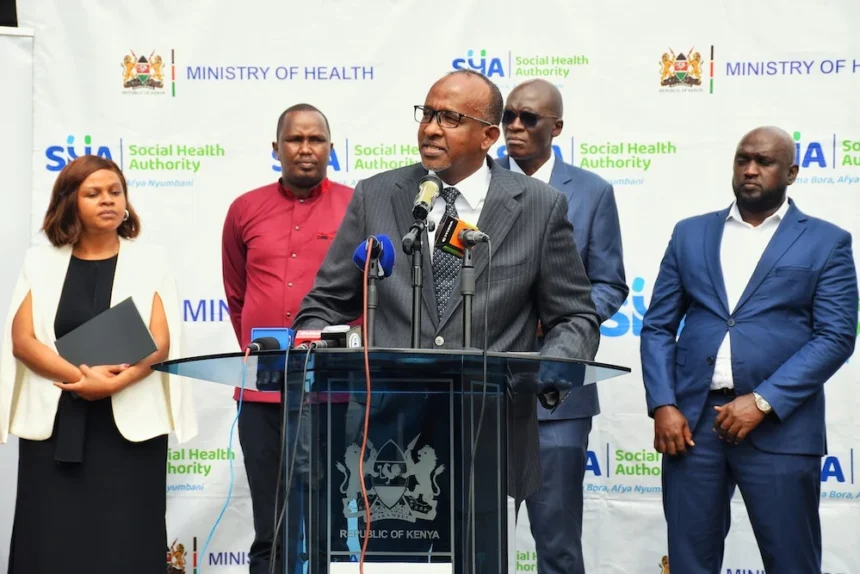
Kenya’s Social Health Authority (SHA) — the centre-piece of the government’s bid for universal health coverage — is under siege, literally, from audit findings, fraud probes and a wave of facility closures that critics say show the scheme is failing and that officials have not been fully transparent.
Evidence of procurement irregularities in a Sh104.8 billion SHA system, suspensions of facilities, and thousands of fraud files handed to police have combined to leave patients and health providers caught in the middle.
Since the launch of SHA, as one of President William Ruto’s pet projects, the health insurance scheme has been shrouded in controversy.
The manner of the launch, the companies who were awarded (including Safaricom and a non-known company based in Abu Dhabi called Apeiro), and the total cost of the tender was suspect.
Many have always felt that the government should have strengthened systems and closed loopholes in the now defunct National Health Insurance Fund (NHIF) which was albeit functioning, unlike SHA.
And that was not all Kenyans were unhappy with. Ruto went ahead to raise the monthly tariffs promised an improved system. But that has not been the case.
What has happened — the short version
Since early 2025 a succession of official reports and media investigations has exposed deep problems around the SHA rollout: an Auditor-General audit flagged unlawful and irregular procurement for the national SHA platform, while audits and forensic checks identified suspicious claims and billing patterns.
After these among many revelations, the Ministry of Health and regulators began suspending and closing facilities suspected of fraudulent activity.
In recent weeks the ministry and SHA have handed over 1,188 alleged fraud files to the Directorate of Criminal Investigations (DCI), and ministers say more closures are likely.
The Auditor-General’s report — and subsequent parliamentary scrutiny — has been central to the crisis.
The damning report highlighted several breaches in the procurement of the system including revealing that the system is apparently not owned by the government. This is very worrying especially since the system handles unique personal identifier data as well as health records of Kenyans.
The report also exposed other breaches in law, including uncompetitive procurement, lack of payment arrangement agreement, unfavourable contract clauses, and lack of risk assessment, among others.
Senators and county oversight committees have repeatedly urged Parliament to act on those findings, describing the procurement structure as opaque and vulnerable to abuse.
The SHA and the Ministry of Health have publicly suspended dozens of providers and say they have closed more than a thousand facilities alleged to have been submitting fraudulent claims or operating without proper registration.
The Ministry’s own release confirmed targeted suspensions, and national broadcasters further reported that the purge has affected more than 1,000 medical outlets — from clinics and dispensaries to private hospitals — as the authorities move to stem what they describe as a “haemorrhage” of public funds.
From audits to criminal probes
On September 1 the ministry and regulatory partners formally handed 1,188 case files to the DCI for further investigation and action. The files were compiled from SHA’s investigations and from the Kenya Medical Practitioners and Dentists Council.
The DCI says it has formed a multi-agency team to review the evidence and pursue prosecutions and asset recovery where warranted. Officials added that the most common fraud schemes included “upcoding” (billing for more expensive procedures), falsified records, and phantom patients.
Cabinet and health officials have publicly defended the cleanup, arguing the closures and handovers show the system is working to protect public funds. The ministry has also pledged to recover misspent money and to push ahead with reforms while continuing roll-out steps aimed at extending coverage.
At the same time, the Ruto’s government an his Health CS Aden Duale have faced calls from MPs and oversight bodies to provide fuller disclosure on contracts, procurement and where public money has moved.
Kenyans to continue suffering
Despite the government’s rhetoric, the immediate effect has been disruptive.
Private and faith-based hospitals have also reported massive unpaid claims and mounting arrears, while some associations have put the sector on notice over delayed reimbursements.
A short strike notice from a private hospitals’ association further revealed tensions between providers and SHA over timeliness and scope of payments. Patients seeking treatment in hospitals also told our reporters that they were being forced to pay out of pocket for services they expected to be covered despite faithfully paying monthly subscriptions to SHA.
In general, public confidence in the scheme has eroded and the health system is almost non-existent for those without private health insurance.
Opposition politicians, health experts and some civil-society groups argue that official briefings have not answered core questions about the SHA contracts, procurement decisions and the role of outside partners. This comes after CS Duale and SHA officials held several press conferences defending the unscrupulous theft of funds from SHA.
The Auditor-General and parliamentary committees have urged a full parliamentary inquiry into the procurement and governance arrangements, and some commentators say selective disclosures have deepened distrust rather than restored it.
Social media and TV exposés however continue to expose amplified anger from Kenyans and their calls for accountability.
What the evidence shows — and what it does not
So far, auditors and investigative teams have produced a catalogue of weaknesses: procurement irregularities, governance gaps, and suspicious billing patterns that together create opportunity for fraud.
Authorities have moved to suspend providers and to seek criminal probes — steps that signal the government is taking action.
But critics point to unresolved questions: actual amounts lost, who benefited, the adequacy of internal controls, and whether systemic design choices made at rollout created the vulnerabilities now being exploited.
Beyond audit figures and police files, ordinary Kenyans are already feeling the consequences.
Clinic closures reduce access in peri-urban and rural areas; unpaid claims hit facilities’ cashflows and can lead to staffing and supply shortages; and uncertainty over what services are covered leaves patients exposed to new, often unaffordable bills.
For many Kenyans the SHA’s promise of easier, cheaper care has been replaced by long waits for answers.