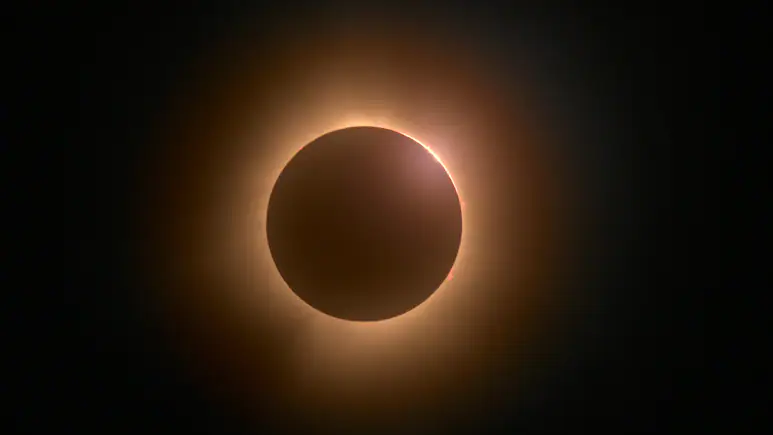
A rare annular solar eclipse will occur on February 17, but only parts of southern Africa and South America will be able to see it.
Skywatchers in select regions of the Southern Hemisphere are set to witness a rare celestial event on Tuesday, February 17, as an annular solar eclipse lights up parts of Africa and South America.
According to NASA, the eclipse will only be visible in “lucky locations” where the Moon’s shadow passes across the Earth.
Where the Solar Eclipse Will Be Visible
The partial eclipse will be seen in parts of southern Africa, including cities such as Cape Town and Durban in South Africa. Some regions of Zimbabwe and Tanzania will also witness the phenomenon.
In South America, areas of southern Argentina and southern Chile are expected to get a partial view.
However, people in most of Asia, Europe, North America and India will not be able to see this eclipse.
Solar Eclipse Timing on February 17
The eclipse will begin at 09:56 UTC (12:56 PM EAT) and reach its maximum at 12:12 UTC (3:12 PM EAT). The entire event will last several hours, although exact viewing times will vary depending on location.
Astronomers note that visibility depends entirely on whether a region falls within the Moon’s shadow path.
What Is an Annular Solar Eclipse?
NASA explains that an annular solar eclipse occurs when the Moon moves between the Earth and the Sun but is too far from Earth to completely cover the Sun.
Because the Moon appears slightly smaller in the sky at that distance, it does not fully block the Sun’s disk. Instead, a bright ring of sunlight remains visible around the Moon.
This striking visual effect is commonly referred to as the “ring of fire.”
During the event, the sky darkens temporarily, but it does not become as dark as during a total solar eclipse.
Why Some Regions Cannot See the Eclipse
Scientists emphasize that a solar eclipse is only visible in areas where the Moon’s shadow passes directly overhead. If the shadow does not cross your location, the event cannot be seen.
As anticipation builds, experts are advising viewers in visible regions to use certified solar viewing glasses to protect their eyes while observing the eclipse.