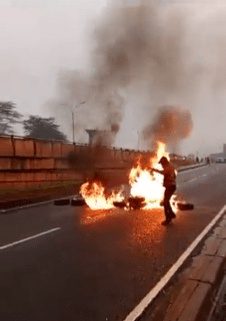
Public transport operations were severely disrupted across several Kenyan towns on Monday as protests over soaring fuel prices spilled onto the streets, triggering clashes with police, road blockades and widespread business closures.
The demonstrations were reported in Nyahururu, Embu, Thika and Chuka, where angry residents, youths and boda boda riders protested against the rising cost of fuel and the increasing cost of living.
Protesters lit bonfires on major roads, blocked streets with stones, logs and burning tyres, and forced many public service vehicle (PSV) operators to suspend services amid growing security concerns.
In Nyahururu, the protests quickly escalated into running battles between demonstrators and police officers. Anti-riot police deployed teargas to disperse crowds that had gathered at key junctions and entry points into the town, according to videos circulating online.
Some protesters responded by throwing stones and chanting anti-government slogans as frustration over high fuel costs boiled over. Thick black smoke from burning tyres hung over parts of the town as security officers attempted to restore order.
The unrest brought normal activities to a standstill. Businesses remained closed throughout much of the day, while matatus stayed off the roads, leaving hundreds of commuters stranded and forcing many residents to walk to their destinations.
Authorities also increased security patrols across the town in an effort to prevent further escalation of the demonstrations.
Similar scenes were witnessed in Embu, Chuka and Thika, where demonstrators blocked roads and lit fires along major transport routes. The disruptions prompted many transport operators to withdraw vehicles from service as a precautionary measure.
The chairman of the Embu Matatu Owners Association, Abraham Gicovi, clarified that PSV operators were not behind the protests but had suspended operations to protect passengers and vehicles from possible attacks.
“We decided to withdraw our vehicles after protesters started lighting fires on the streets. We feared some vehicles could be attacked or burnt,” said Gicovi.
Despite distancing the transport sector from the demonstrations, Gicovi expressed support for the concerns being raised by Kenyans, arguing that many citizens are struggling under the burden of rising fuel prices and broader economic challenges.
Several residents who spoke during the protests also voiced support for peaceful demonstrations but condemned incidents in which some motorists were reportedly attacked and vehicles stoned.
The demonstrations come amid mounting public anger following the latest fuel price review announced by the Energy and Petroleum Regulatory Authority earlier this month.
Under the May 14 review, the price of Super Petrol increased by Sh16.65 per litre, while diesel rose sharply by Sh46.29 per litre.
The adjustments pushed pump prices in Nairobi to Sh214.25 for petrol and Sh242.92 for diesel, triggering outrage among motorists, matatu operators, boda boda riders and transport companies.
Industry players have warned that the higher fuel costs are likely to drive up transport fares and further increase the cost of essential goods and services, worsening economic pressures already facing many households.
The latest protests also come just days after public transport operators called off a planned nationwide strike following talks with President William Ruto at State House in Mombasa.
The strike had initially been suspended on May 19 after a two-day nationwide stoppage that disrupted businesses and transport services across the country. PSV operators had agreed to halt industrial action for seven days to allow negotiations with the government.
Following the discussions, the Federation of Public Transport Sector announced that the strike had been fully called off.
Federation chairperson Edwins Mukabanah said operators had chosen to prioritise economic stability and urged all stakeholders to honour the agreements reached during the consultations.
However, Monday’s demonstrations indicate that public dissatisfaction over fuel prices and the rising cost of living remains high, with pressure continuing to mount on the government to address the concerns of ordinary Kenyans.