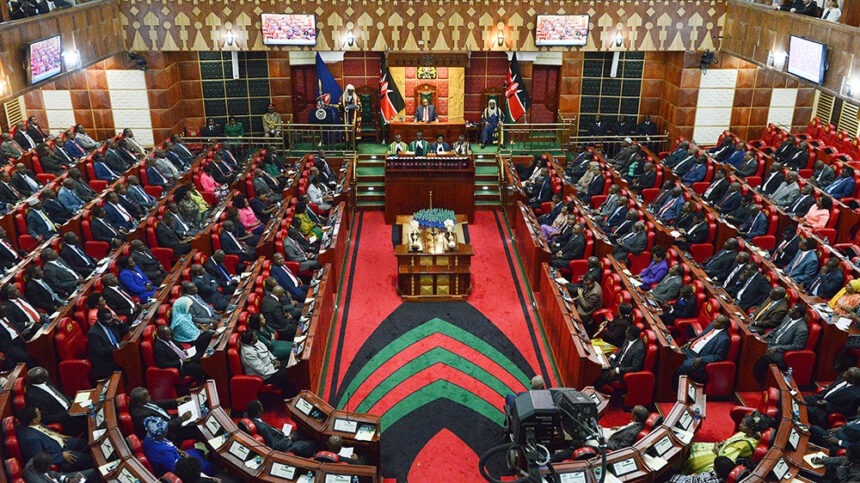
Treasury Cabinet Secretary John Mbadi is set to present the much-anticipated 2025/2026 budget today at the Parliament Buildings in Nairobi.
This will be his first budget under the Kenya Kwanza administration, and it follows one of the most tumultuous years in Kenya’s financial history.
President William Ruto’s government plans to spend over Ksh 4.2 trillion next year—financed through taxes, ordinary revenue, grants, fees, and borrowing.
The tax burden has stirred particular attention: the government aims to collect Ksh 2.7 trillion in direct taxes, which equates to about 64% of the budgeted amount.
Additional revenue from levies and fees—known as Appropriations-in-Aid—is projected at Ksh 560 billion, bringing the total domestic revenue to around Ksh 3.3 trillion.
Grants amounting to Ksh 46.9 billion reduce the funding gap to approximately Ksh 876 billion, which the state plans to fill mainly through borrowing—Ksh 592 billion domestically and Ksh 284 billion externally.

Kenyans will be watching this budget closely.
Notably, memories of last year’s proposed Ksh 344 billion in tax hikes remain fresh.
Those measures triggered nationwide protests that turned violent, leading to more than 50 deaths and the temporary abduction of young protesters.
Ultimately, the backlash forced President Ruto to withdraw the Finance Bill and stall an International Monetary Fund (IMF) programme review.
This year, Mbadi appears to have absorbed the message. He has firmly ruled out any new tax hikes in this Finance Bill, instead focusing on broadening the tax base, plugging loopholes, and improving compliance.
“Kenyans cannot bear more tax,” Mbadi stated on Wednesday, insisting the Kenya Revenue Authority (KRA) must be empowered to collect what is already due—even as privacy groups caution against giving the agency broad access to bank and mobile money data.
Analysts are cautiously optimistic but warn that raising revenue without new taxes means tight execution.
Public expectations are however very high. For young, socially engaged Kenyans—who led the “Reject Finance Bill” protests—this budget represents more than just numbers; it is a test of whether the government has learned from last year’s upheaval.
Civil society groups have also urged sensitivity to living costs, arguing that the previous tax proposals disproportionately impacted essential everyday items like bread, fuel, and mobile data .
Economists, for their part, warn that failure to meet targets could undermine IMF relations and spook investors.
A renewed IMF loan—now expected to accompany this budget—hinges on improved fiscal discipline.
But mostly, for an administration that has been accused of corruption and opulence while Kenyans are overtaxed, this will be a very tough test for the coming days.