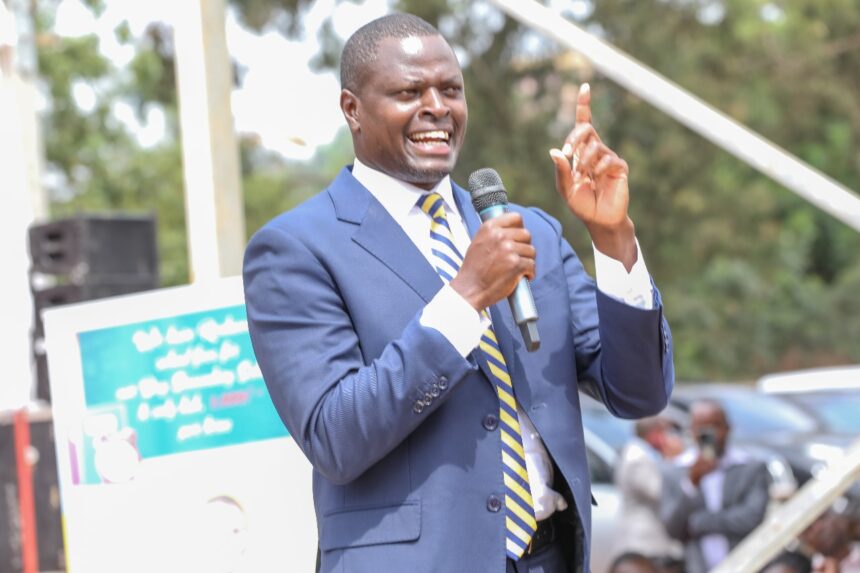
Ndindi Nyoro, the Member of Parliament for Kiharu, has raised concerns over the government’s newly launched National Infrastructure Fund, warning that it could pave the way for increased borrowing outside the country’s official national budget.
Speaking in Gakurwe, Nyoro said the fund could allow the government to engage in what he described as “off-the-books” borrowing at a time when many Kenyans are already struggling with declining incomes and the high cost of living.
According to the legislator, Kenya’s debt levels have risen sharply in recent years, placing growing pressure on the economy and future generations. He claimed that the government is currently borrowing about Sh1.5 trillion annually, an amount he said translates to roughly Sh4 billion every day.
Nyoro questioned the need for a new financing structure when infrastructure development projects can still be funded through the normal national budget and traditional financing channels.
“The fund that was launched yesterday is simply another way of borrowing money off the books,” he said.
The National Infrastructure Fund, estimated at Sh5 trillion, was introduced by the government as a vehicle to mobilise financing for large-scale infrastructure projects such as roads, airports and other strategic developments.
Officials say the initiative is designed to attract private capital and international investors, allowing the country to expand infrastructure financing beyond conventional government budget allocations.
The government has also compared the proposed structure to sovereign investment funds used in countries such as the United Arab Emirates, Australia and Singapore. These funds are typically backed by strong national reserves and are used to invest in strategic assets while generating long-term returns.
However, Nyoro argued that such comparisons may not accurately reflect Kenya’s economic reality. He noted that sovereign wealth funds are usually established by countries that already have surplus resources to invest globally rather than as mechanisms for raising additional debt.
“That is a contradiction. Those countries created such funds after their economies had grown to invest for the future. But the fund that was launched yesterday is meant to borrow more money outside the budget,” he said.
Nyoro cautioned that sustained borrowing at the current pace could undermine Kenya’s long-term economic stability and saddle future generations with heavy debt obligations.
“It is not right for us to continue burdening Kenyans today and also burden future generations,” he said, urging greater caution in expanding the country’s debt levels.
The MP also contrasted the current borrowing trends with those during the administration of former President Mwai Kibaki. According to Nyoro, Kibaki’s government borrowed about Sh1.2 trillion over his entire ten-year tenure, significantly less than what the country is currently borrowing within a single year.
Nyoro made the remarks during the launch of Mwai Kibaki Secondary School in Kiharu, a new institution built through the National Government Constituencies Development Fund (NG-CDF).
He explained that the school was named in honour of the late president to recognise his role in transforming Kenya’s economy and expanding access to education.
Nyoro credited Kibaki’s administration with introducing key development policies such as free primary education, expanding the national road network and accelerating rural electrification—initiatives he said significantly improved livelihoods and strengthened the country’s economic foundation.