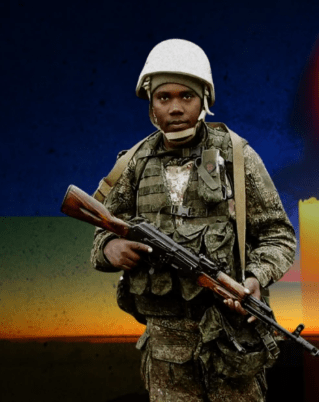
A grieving family in Kisii County has held a symbolic burial for their son after losing hope that his body will ever be returned home from the war in Ukraine.
The family of Clinton Nyapara carried out the emotional ceremony on Tuesday in Bomariba Village, choosing to plant a tree in place of his remains.
Nyapara, a young Kenyan who reportedly died in Donetsk, is believed to have been fighting for the Russian Armed Forces after joining the military last year.
In the village, preparations for the burial began like any other funeral. A grave was dug and relatives gathered, but there was no body to lower into the ground. Instead, the family planted a tree — a symbolic act meant to mark the final resting place of a son who died thousands of kilometres from home.
Nyapara had left Kenya in search of better opportunities, hoping to improve his life and support his family. Instead, he became one of several Kenyans believed to have died after being recruited into the war linked to the Russia–Ukraine War.
Three months after receiving news of his death, the family says they are still waiting for answers and the possible repatriation of his remains. But after weeks of unsuccessful appeals to the Ministry of Foreign and Diaspora Affairs (Kenya), they decided to perform a special ritual to find closure.
Nyapara’s brother said the family had exhausted all options.
“Tumejaribu juu chini but imeshindikana… tukaamua wacha sasa huu mti uwekwe hapa,” he said, explaining that planting the tree was the only way the family could finally mourn their son.
For them, the tree now stands as a permanent reminder of a life lost far from home and a dream that ended on a distant battlefield. The family hopes that Nyapara’s aspirations will live on through the son he left behind — a six-year-old boy.
Growing concern over recruitment of Kenyans
Nyapara’s case is not isolated. Reports from different parts of Kenya indicate that a growing number of young men are being recruited — sometimes deceptively — to join the Russian military.
In Trans Mara East, families say at least 15 young men have gone missing under unclear circumstances. Relatives fear the youths may have been lured into the war with promises of employment abroad.
In Nagwenya Village, parents say recruiters targeted vulnerable young men who were desperate for jobs and opportunities outside the country.
Investigations and testimonies from affected families suggest that recruiters often approach youths through social media platforms such as TikTok, Telegram and WhatsApp, or through informal labour agents promising lucrative work abroad.
In some cases, the young men are reportedly promised jobs as security guards, construction workers or logistics staff in Russia, only to discover after arrival that they are expected to sign military contracts.
Others are allegedly offered monthly salaries ranging from $2,000 to $3,000, along with promises of Russian residency or citizenship — incentives that can be tempting for unemployed youths.
Once recruited, some are reportedly transported through intermediary countries before being deployed to front-line regions in eastern Ukraine, including Donetsk, one of the most dangerous theatres of the war.
Human rights groups and security analysts say the recruitment targets economically vulnerable populations across Africa, including Kenya, where high youth unemployment makes such offers attractive.
For families in villages like Bomariba and Nagwenya, however, the consequences are devastating.
Parents who watched their sons leave with hopes of a better future now live with uncertainty and fear — unsure whether they will ever hear from them again or whether, like Nyapara’s family, they will one day be forced to mourn without a body to bury.