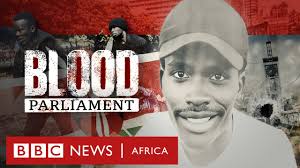
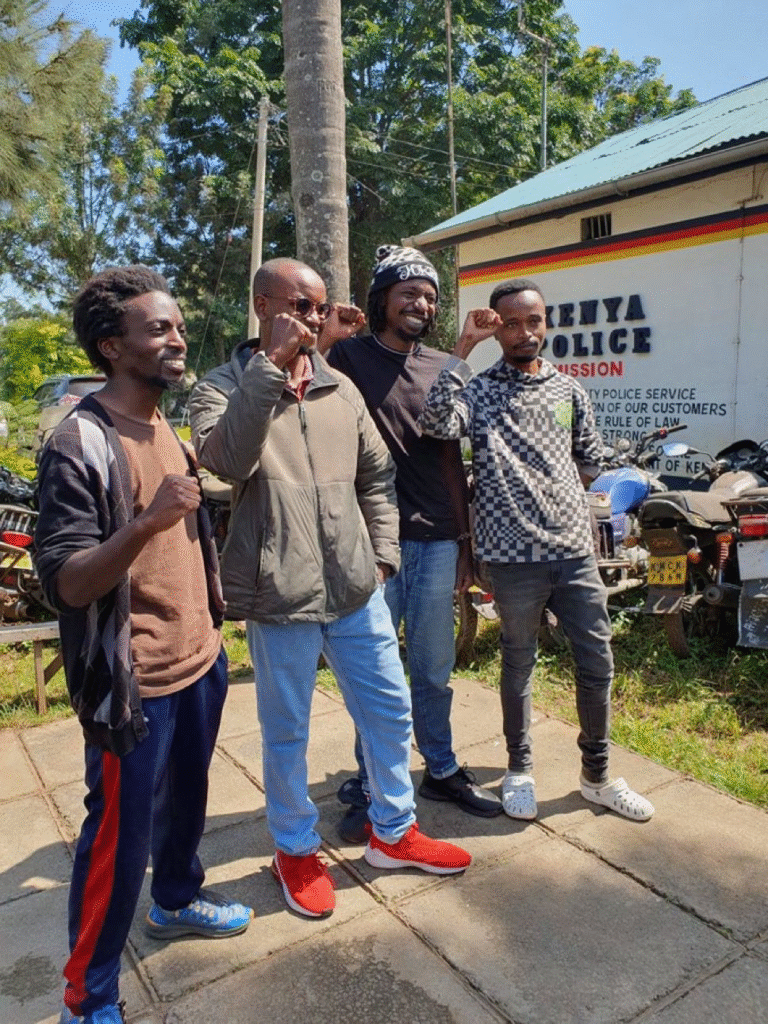
Four Kenyan filmmakers who were arrested on Friday night in relation to the damning BBC expose ‘Blood Parliament’, and who had been booked for “false publication” have been released on free bond, their legal team has confirmed. However, their devices remain in police custody.
Nicholas Wambugu Gichuki, Brian Adagala, Mark Karubiu, and Christopher Wamae were picked up from their studio in Karen, Nairobi, and detained at Pangani Police Station.
Their arrest, which drew swift public condemnation and sparked concern within Kenya’s creative and human rights communities, has not resulted in any formal charges so far.
According to lawyer Ian Mutiso, no cash bail was required for their release. He also took a moment to commend Defenders Coalition and Vocal Africa, two advocacy organisations that had prepared to post bail if needed.
“This was a collaborative effort by the Law Society of Kenya (LSK), the media, and civil rights groups,” Mutiso said.
“I personally followed up at Pangani Police Station and spoke with the regional commander and other officers to get details on the arrest.”
Mutiso further revealed that the directive to detain the filmmakers came from DCI headquarters, not the local DCIO at Pangani.
“I was informed that the operation was being coordinated from the top, and we will now engage with DCI headquarters alongside the LSK leadership to determine the intended charges and the progress of investigations,” he added.
Arrest Linked to Controversial BBC Documentary
Sources familiar with the matter claim that detectives had been trailing the four in connection to a recent BBC Africa Eye documentary.
The 40-minute exposé alleged that Kenyan security forces fired live ammunition at anti-tax protesters outside Parliament during the June 2024 Gen Z demonstrations.
The film, which aired just days before the arrests, has ignited widespread public outcry and drawn international scrutiny over claims of police brutality and extrajudicial killings.
In response to the documentary’s revelations, Director of Public Prosecutions Mulele Ingonga has directed the Independent Policing Oversight Authority (IPOA) to formally investigate the incidents surrounding the protests.
Industry Outrage and Solidarity
The arrests have drawn sharp criticism from the creative industry. In a strongly worded statement, the Kenya Film and Television Professionals Association (KFPTA) condemned the police action, terming it a serious threat to artistic freedom and an attack on the country’s creative community.
“This is a worrying assault on the rights of storytellers and filmmakers in Kenya,” said Onyango, a representative of the association.
“We demand full transparency regarding the charges and detention conditions, and we stand in unwavering solidarity with our arrested colleagues, their families, and the entire creative sector.”
Reports suggest the four filmmakers were being prepared for possible charges related to publishing false information and cyberbullying, though no official details have been disclosed.
As it stands, the legal team is pursuing the return of the filmmakers’ confiscated devices and remains on high alert for any further developments.