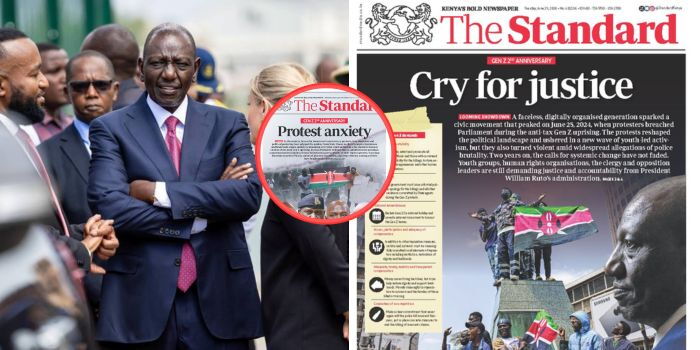
The Standard Group PLC has strongly defended its journalism and editorial independence following a public confrontation with William Ruto, escalating tensions between the media house and the government.
In a statement issued on June 24, 2026, and signed by Group CEO Chaacha Mwita, the media company rejected allegations by President Ruto that it was engaged in “extortionist propaganda” and attempting to blackmail his administration through critical reporting.
The president’s remarks followed a series of investigative reports and headlines scrutinising his government’s performance, policy decisions, and campaign promises. In a post on X, Ruto challenged the media house and its perceived association with former Gideon Moi, saying continued criticism would achieve “nothing and nowhere.”
Standard Rejects Propaganda Claims
Responding to the accusations, Standard Group insisted that its reporting is driven by facts, public interest, and professional ethics.
“The Standard is not a propaganda outlet. Our journalism is guided by facts, public interest and professional ethics,” the company said.
The media house argued that public criticism of journalists by the Head of State raises concerns about the operating environment for independent media and should instead be addressed through established channels.
“Watchdog, Not Cheerleader”
The company reaffirmed its role as a watchdog in a democratic society, saying its responsibility is to hold leaders accountable regardless of political affiliation.
“The media’s role in a democracy is to act as a watchdog. We take this responsibility seriously. We cannot celebrate the failures of leadership, because when government fails, the country pays the price.”
Standard Group further maintained that editorial decisions are made independently and are not influenced by political figures or external interests.
“The Standard Group PLC does not take instructions from any individual or office. Our independence is the foundation of our credibility and our service to the public.”
Raises KSh 1.2 Billion Advertising Debt Issue
The company also pushed back against allegations of blackmail by pointing to what it says is an outstanding government advertising debt of approximately KSh 1.2 billion.
According to Standard Group, the unpaid bills have negatively affected its operations and employees, arguing that the media house is the victim rather than the perpetrator of pressure tactics.
“What greater form of blackmail is there than a government withholding KSh 1.2 billion that it owes us?”
Concerns Over Media Freedom
The media organisation reminded President Ruto of previous public statements supporting press freedom and urged the government to uphold constitutional protections for journalists and media institutions.
It also warned that it would hold the government accountable should any harm come to its journalists, management, shareholders, or business operations following the president’s remarks.
Constitutional Duty
Despite the dispute, Standard Group said it would continue carrying out its constitutional mandate of informing the public, scrutinising those in power, and safeguarding the public’s right to know.
The standoff represents one of the most direct public confrontations between President Ruto and a major Kenyan media house since he assumed office and is expected to intensify debate around press freedom, government accountability, and the role of independent journalism in Kenya’s democracy.