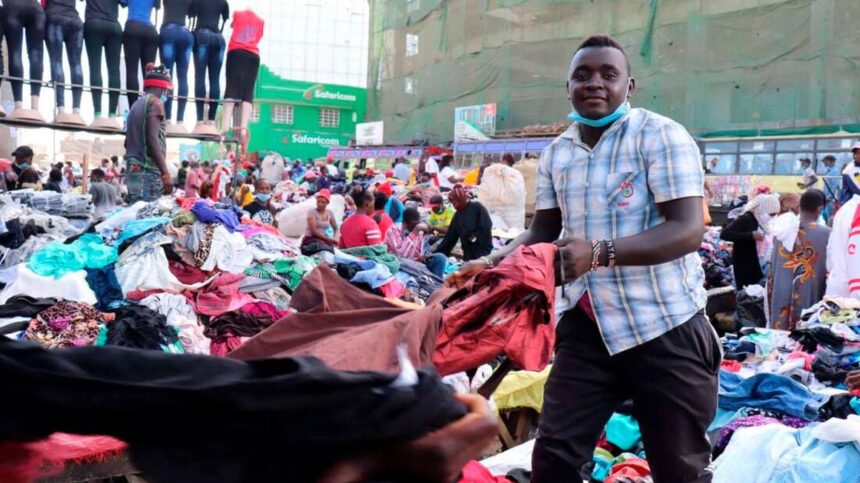
Kenyans spent over Sh60 billion on new clothes last year compared to Sh28 billion which was used to import used clothes commonly known as mitumba, a new report has said.
The report dubbed A Future Look at the Apparel and Footwear Industry in Kenya (2022–2037), has found that Kenya’s second-hand clothing (Mitumba) sector is a critical part of Kenya’s economy, job market and future, and not a threat to local manufacturing.
Speaking during the launch at a Nairobi hotel, Mr. Kwame Owino, the Chief Executive Officer of the Institute of Economic Affairs (IEA-Kenya) said, “It is not true that the availability of used clothes is the cause for failures in domestic textile companies.”
The Mitumba (second-hand clothing) trade is a vital part of Kenya’s economy, supporting the livelihoods of approximately 2 million people—primarily women, youth, and informal traders across all counties.
It contributes significantly to government revenue, generating about Ksh 12 billion annually in taxes. For many households, Mitumba offers an affordable alternative to new clothing, with the average household spending Ksh 409 per quarter on used items compared to Ksh 783 on new ones.
Notably, 91.5% of households that purchase second-hand clothes spend less than Ksh 1,000 per quarter, underscoring the trade’s role in bridging the affordability gap.
In 2019 alone, Kenyans spent Ksh 197.5 billion on both new and used clothing and footwear. Additionally, there is a strong link between income growth and Mitumba consumption; a 1% increase in income correlates with a 12% rise in the demand for second-hand clothing.
Data from the Economic Survey 2025 shows that Kenyan textile imports for 2024 were about Ksh 60 billion compared to Mitumba’s Kes 28 billion.
“Today, we are not here to defend Mitumba. We are here to celebrate its role in Kenya’s economy and to prove that it can coexist with local manufacturing to create jobs, drive growth and keep Kenya fashionably ahead,” said Teresia Njenga, MCAK Chairperson.
According to the report, a liberalised policy environment with strategic support for both sectors is necessary to generate the highest employment, revenue and economic welfare.
Further, used clothes and new clothes do not compete, as they serve different market needs. They have distinct value chains, pricing models and consumers.
The study gives a case study of Pakistan which has successfully balanced thriving textile exports with substantial second-hand imports. This offers Kenya a model of industrial and inclusive economic policy.