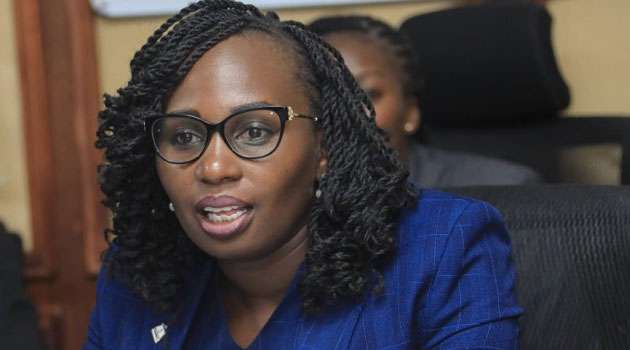
Nairobi, Kenya – Monday, October 6, 2025 — Law Society of Kenya (LSK) President Faith Odhiambo has officially resigned from her position as the Vice Chairperson of President William Ruto’s Panel of Experts on the Compensation of Victims of Demonstrations and Public Protests, citing conflicting oath obligations.
Odhiambo’s decision comes just days after she accepted the controversial government appointment, which had sparked widespread debate within legal and political circles.
Cites Oath Demands and Conflict of Interest
In her resignation statement, Odhiambo said her continued service on the panel would contradict the independence and integrity of her office as LSK President, noting that the Society’s mandate requires it to remain non-partisan and uphold the rule of law without executive influence.
“Upon reflection and consultation with members of the Council, I have found that continuing to serve on the panel would be inconsistent with the oath I took as President of the Law Society of Kenya,” Odhiambo stated.
She added that while the panel’s objective—to compensate victims of demonstrations and public protests—was noble, her role as LSK President demands neutrality in government-led initiatives that may be subject to public or legal scrutiny.
Background on the Controversial Appointment
President Ruto appointed the panel two weeks ago through an Executive Order, aiming to address claims of human rights violations and property losses resulting from recent nationwide protests.
Odhiambo’s inclusion in the team, however, drew backlash from sections of the legal fraternity and civil society, who questioned the propriety of her accepting a state appointment while serving as head of the LSK—a body that often challenges the government in court.
Her resignation is seen as an effort to restore the Society’s credibility and independence amid growing criticism.
LSK’s Position on the Panel
The LSK Council had earlier distanced itself from the appointment, saying it had not been consulted and that Odhiambo’s acceptance was made in her personal capacity.
Following her resignation, several lawyers and human rights advocates have lauded the move as a principled decision that reaffirms the Society’s long-standing role as a watchdog of governance and constitutionalism.