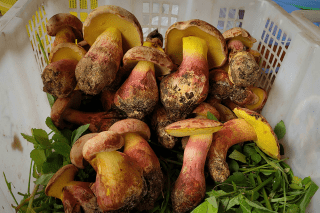
NAIROBI, Kenya, Jan 7 – Scientists are investigating a rare mushroom that causes people in different parts of the world to experience the same strange hallucinations, including visions of tiny, elf-like figures moving through rooms.
Every year, hospitals in Yunnan Province, China, treat hundreds of patients who report seeing miniature beings crawling on walls, walking across furniture and marching under doors.
Doctors have linked these cases to Lanmaoa asiatica, a wild mushroom that grows near pine trees and is widely eaten during peak mushroom season.
Popular Delicacy With a Dangerous Twist
In Yunnan, Lanmaoa asiatica is sold in open-air markets, served in restaurants and cooked in homes between June and August. People prize it for its rich umami taste.
However, locals know one crucial rule: cook it thoroughly.
Otherwise, hallucinations can begin within hours.
“At some restaurants, servers actually set timers and warn customers not to eat the mushroom early,” said Colin Domnauer, a biology doctoral researcher at the University of Utah and the Natural History Museum of Utah. “If you don’t wait, you might see little people.”
As a result, accidental intoxication remains common despite widespread awareness.
A Long-Standing Scientific Mystery
Although communities in China have known about the mushroom for decades, scientists struggled to identify it.
“There were many stories, but no confirmed species,” said Giuliana Furci, founder of the Fungi Foundation, a global organisation dedicated to fungal research and conservation.
That changed in 2015, when researchers formally described Lanmaoa asiatica. Even then, its psychoactive effects remained poorly understood.
Historical Accounts Match Modern Cases
Interestingly, similar hallucinations appeared in scientific literature decades earlier.
A 1991 study by the Chinese Academy of Sciences described patients experiencing “lilliputian hallucinations,” a rare condition where people see tiny humans or fantasy creatures. The figures appeared repeatedly and vividly, especially when patients closed their eyes.
Earlier still, in the 1960s, renowned ethnomycologists Gordon Wasson and Roger Heim reported comparable cases in Papua New Guinea. They sent samples to Albert Hofmann, the Swiss chemist who discovered LSD. However, Hofmann found no known psychedelic compounds.
Because of that, researchers dismissed the reports at the time.
Not Psilocybin — Something New
Recent research suggests Lanmaoa asiatica does not contain psilocybin, the compound found in so-called magic mushrooms.
According to Domnauer, the hallucinations caused by L. asiatica last far longer — often 12 to 24 hours, and in some cases several days. Some patients require hospitalisation due to confusion, dizziness and delirium.
Unlike other psychedelics, the hallucinations are also remarkably consistent.
“I don’t know of anything else that causes the same visions so reliably,” Domnauer said.
Global Sightings Raise Bigger Questions
Domnauer has since identified the same mushroom species in the Philippines, despite visual differences. Genetic testing confirmed they were identical.
Meanwhile, researchers searching Papua New Guinea in late 2025 failed to locate matching samples. This raises two possibilities.
Either the same species exists across vast regions — or different mushrooms evolved the same neurological effects independently.
Scientists recently discovered that psilocybin evolved separately in unrelated fungi, according to research cited by Nature. Therefore, parallel evolution remains possible.
What This Means for Brain Science
Experts say studying Lanmaoa asiatica could unlock new insights into how the human brain creates hallucinations.
According to Dennis McKenna, director of the McKenna Academy of Natural Philosophy, understanding the mushroom’s compounds may reveal where lilliputian hallucinations originate in the brain.
Data from the US National Institutes of Health (NIH) shows that fewer than 230 non-drug-related cases of lilliputian hallucinations have been documented since 1909. Alarmingly, about one-third of patients never fully recover.
As a result, identifying the mushroom’s active chemical could eventually support new neurological treatments.
A Vast World Yet Undiscovered
Scientists estimate that less than 5% of all fungal species have been formally identified. According to the BBC, fungi may hold one of the largest untapped libraries of medicinal compounds on Earth.
“Fungi contain enormous biochemical potential,” Furci said. “We are only beginning to understand what they can offer.”
As ecosystems continue to shrink, discoveries like Lanmaoa asiatica highlight the urgent need for conservation — not just for nature, but for future medical breakthroughs.