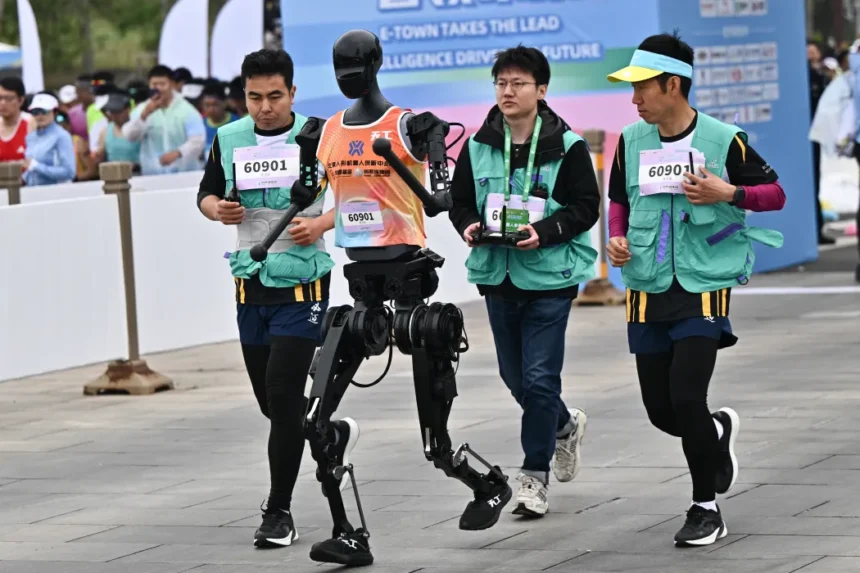
The crack of starter pistols on a brisk Saturday morning outside Beijing signaled the start of a historic event—the world’s first humanoid robot half marathon.
As gears spun and joints clicked into motion, 20 bipedal robots launched forward, sharing the track with human runners and redefining the future of athletic competition.
For the first time ever, humanoid machines competed over a 21-kilometer course, merging innovation and endurance in a groundbreaking display of robotic engineering. The event marked a major milestone in the evolution of robotics and artificial intelligence.
China’s robotics startups have been gaining global attention for creating humanoids capable of stunts like backflips, Tai Chi, and dance. But now, thanks to rapid progress in AI and biomechanics, these machines are transitioning from lab-bound prototypes to agile athletes—ready to compete in public view.
The half marathon course challenged the robots with asphalt, slopes, puddles, and uneven surfaces. To keep them moving, engineers were allowed to perform battery swaps during pit stops—echoing Formula 1 racing strategies.
Before the race, teams of engineers gathered around their robots for final system checks and code debugging. Tension was high. Few robots had ever attempted such a distance, and even finishing the race seemed ambitious.
One of the favorites was Tien Kung Ultra, clad in an orange vest and engineered for strength and agility. The 1.8-meter-tall robot had previously scaled over 100 outdoor steps, and it clocked the fastest time in the 5-kilometer qualifying round. But a leg crack during pre-race testing put its performance in doubt.
Within the first 100 meters, one robot wearing a lifelike female face mask collapsed. Another—just 75 centimeters tall in a silver suit—nimbly overtook it. Xuanyuan, known for its emotion-recognition AI, stumbled but managed to recover and continue cautiously.
“When a human falls, they just get up. For a robot, it requires synchronized movements across multiple high-torque joints,” explained Yang Guodong, co-founder of CASBOT SE.
While none of the robots achieved full running strides—they more closely resembled speed-walkers—the race offered a glimpse into the capabilities of next-generation humanoid tech.
At the 16-kilometer mark, drama struck when Tien Kung collapsed. Engineers quickly rolled out a backup unit, though swapping would mean a 10-minute penalty. After a tense five-minute reboot, Tien Kung resumed the race under the watchful eye of a Xiaomi SU7 electric pace car.
Noetix’s N2, a 1.2-meter robot with a human-like gait, impressed early but fell behind after multiple battery swaps. Meanwhile, creativity flourished—one robot had oversized, mantis-like legs, another wore a floppy fishing hat, and footwear ranged from athletic shoes to rain boots.
Entertainment was part of the spectacle. One robot broke into a mid-race dance, while another veered into the railings, drawing laughs from onlookers.
Despite the comical setbacks, the event was a serious proving ground. Six robots finished the entire 21-kilometer course. Tien Kung completed it in 2 hours and 40 minutes, maintaining an average pace of 8 km/h—an impressive milestone in humanoid mobility.
“This was exactly the performance we hoped for,” said Xiong Youjun, General Manager of the Beijing Humanoid Robot Innovation Center. “Completing the race is more meaningful than winning—it’s a major step toward integrating robots into daily life.”
N2 placed second, and a robot from Shanghai-based DroidUp took third. Enthusiastic supporters followed the mechanical finishers in a celebratory procession as the race concluded at Beijing E-Town, a tech hub known for its focus on robotics, semiconductors, biotech, and spaceflight.
“Humanoid robots are built from thousands of parts, requiring a vast industrial chain,” said Liang Liang, an official from the Beijing Economic-Technological Development Area (BDA). “China’s manufacturing strength is a major asset in leading this innovation.”
Not all of China’s robotics giants participated. UBTECH, based in E-Town, focuses on industrial robots already in use in auto plants. Shanghai’s Kepler K2 robots, capable of lifting 30 kilograms, are undergoing trials for logistics roles.
Currently, China operates around 470 industrial robots per 10,000 manufacturing workers. As humanoid robots advance, they are expected to take on more cognitive and dynamic roles.
“This race is a symbol,” said Li Quan, BDA official and co-organizer. “It’s not just about speed—it’s about ambition. The journey toward true human-robot collaboration doesn’t end here.”