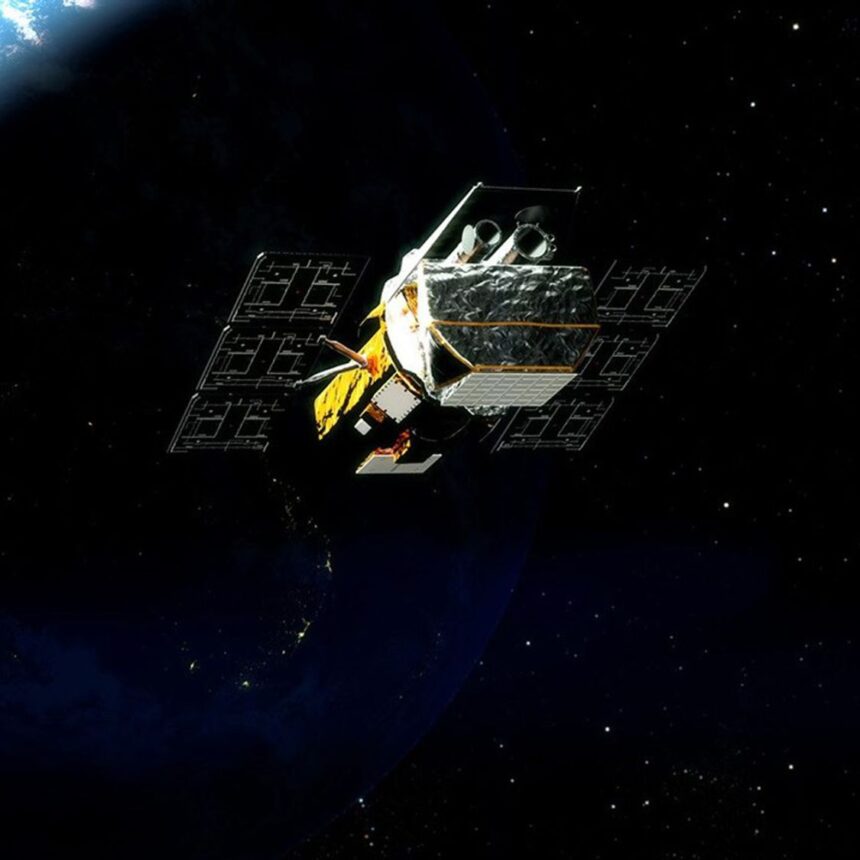
A NASA-funded spacecraft has been launched on a pioneering mission to rescue the aging Neil Gehrels Swift Observatory, which has been steadily losing altitude and faces the risk of re-entering Earth’s atmosphere in the coming months.
The unprecedented mission is being led by Arizona-based aerospace startup Katalyst Space Technologies, whose robotic spacecraft, Link, is designed to rendezvous with the 21-year-old observatory before its orbit decays beyond recovery.
Robotic Spacecraft to Raise Swift’s Orbit
Once it reaches the observatory, Link will use three robotic arms to securely latch onto Swift before performing a carefully controlled series of orbital boosts to raise the telescope into a safer, higher orbit.
If successful, the mission will mark the first time a commercial spacecraft has attempted to rescue and extend the operational life of an orbiting scientific observatory through an in-space servicing mission.
Telescope Has Exceeded Its Planned Lifespan
Launched in 2004, the Neil Gehrels Swift Observatory has far outlived its original mission timeline and remains one of NASA’s most valuable space observatories.
Swift plays a crucial role in detecting gamma-ray bursts—the most energetic explosions known in the universe—while also supporting research into black holes, neutron stars, supernovae, and other high-energy cosmic events.
Solar Activity Accelerated Orbital Decay
According to mission officials, increased atmospheric drag caused by heightened solar activity has accelerated Swift’s orbital decay, placing the telescope at risk of re-entering Earth’s atmosphere and burning up as early as October if no intervention is made.
The rescue mission aims to preserve one of NASA’s longest-serving scientific assets, allowing it to continue delivering valuable astronomical observations while demonstrating new capabilities for servicing satellites and spacecraft already in orbit.