Fresh concerns have emerged over the conduct of police officers involved in the final hours of teacher and influencer Albert Ojwang’s life, following the release of chilling CCTV footage from Mbagathi Hospital.
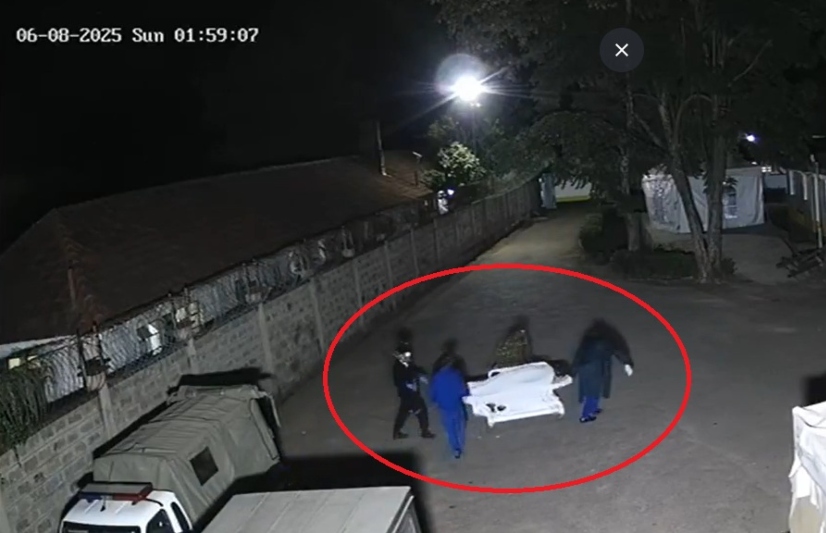
The 40-minute surveillance video, shows that Ojwang was brought to the hospital in a lifeless state in the early hours of June 8, 2025, and received no urgent medical attention despite being in apparent need of emergency care.
The footage captures a police Land Cruiser arriving at 1:35 a.m. with three officers on board. Two officers immediately alight and begin conversing, with the driver following slowly behind. However, rather than rushing Ojwang into the emergency wing, the officers appear distracted.
One officer receives a phone call, prompting all three to retreat toward the vehicle, where they remain outside for three minutes, engaged on their phones, while Ojwang remains unattended in the back of the van.
At 1:40 a.m., two officers re-enter the hospital in search of medical staff. They return six minutes later, accompanied by a stretcher and a hospital security guard. It takes a further ten minutes to lift Ojwang from the vehicle and wheel him into the hospital.
By the time he is admitted to the casualty ward at 1:59 a.m., 24 minutes had passed since the officers’ arrival.
At 2:09 a.m., hospital staff officially declared Ojwang brought in dead. An internal hospital incident report noted that he was unresponsive, had no cardiac activity, and his body was already cold to the touch. He also had visible injuries, including swelling on the face and a cut at the back of his head, consistent with blunt force trauma.
At 2:10 a.m., CCTV shows officers wheeling Ojwang’s body back out of the hospital. The police vehicle departed five minutes later for City Mortuary, where the body was formally received and later identified by his family.
Investigations are ongoing, with the Independent Policing Oversight Authority (IPOA) and DCI homicide detectives now leading a wider probe into Ojwang’s death and the actions of at least 17 officers and civilian accomplices.
.