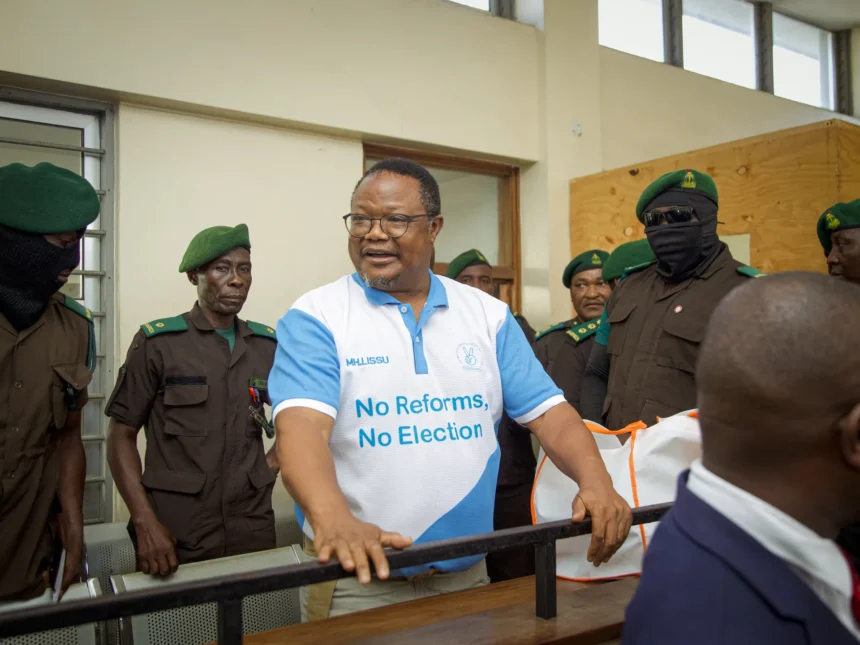
Dar es Salaam, October 5, 2025: Tanzanian opposition leader Tundu Lissu faces trial for treason on Monday, only weeks before the national elections. His party, CHADEMA, remains barred from contesting the October 28 polls.
Lissu, who came second in the 2020 presidential race, was arrested in April. Prosecutors accuse him of urging citizens to rebel and disrupt the upcoming elections.
Election Tensions and Opposition Crackdown
The Chama Cha Mapinduzi (CCM) party, led by President Samia Suluhu Hassan, has ruled Tanzania since independence in 1961. Lissu argues that the electoral system favours the ruling party, leaving no room for fair competition.
“Without serious reform, this election cannot be free or fair,” he said before his arrest.
Human rights organisations have criticised his detention.
Amnesty International warned that the government is stifling dissent, while Human Rights Watch has linked the crackdown to politically motivated arrests and disappearances.
For more updates on East African politics, visit sauce.co.ke/news.
Court Bans Live Coverage
The court has barred live coverage of Lissu’s trial after state prosecutors claimed it could expose witnesses. Lissu’s defence team, led by Peter Kibatala, argues that the case is meant to silence opposition voices.
“This is not about national security. It’s about stopping dissent,” Kibatala told reporters.
The United Nations Human Rights Office (OHCHR) has previously urged Tanzanian authorities to ensure due process and transparency in politically sensitive trials.
A Survivor Turned Opposition Symbol
Lissu’s political journey is defined by resilience. In 2017, gunmen shot him 16 times outside his Dodoma home. He survived after multiple surgeries in Kenya and Belgium, though no one was ever prosecuted.
After his recovery, Lissu became a powerful symbol of resistance against state repression. His return to Tanzania in 2020 drew thousands of supporters who saw him as a beacon of democratic hope.
Hassan’s Leadership Faces New Scrutiny
President Samia Suluhu Hassan initially won praise for relaxing media restrictions and inviting dialogue with opposition leaders after the death of John Magufuli. However, optimism has since faded.
Reports of enforced disappearances and harassment of opposition members have increased.
Both BBC Africa and Al Jazeera have highlighted cases of activists being detained or going missing.
The United Nations and East African Community (EAC) have also called for credible elections and respect for fundamental freedoms.
“Open political competition strengthens democracy and ensures legitimacy,” a UN spokesperson said recently.
CHADEMA’s Disqualification and Public Reaction
The Tanzania Electoral Commission barred CHADEMA from the election in April, claiming it failed to sign a required code of conduct.
Critics argue the ban was politically motivated, pointing to similar disqualifications of other opposition leaders.
With CHADEMA out, analysts expect the CCM to win comfortably. Political observers warn that excluding key opposition voices could worsen instability and public mistrust.
“This trial tests Tanzania’s commitment to democracy,” said political analyst Abdallah Mwampaja.
Lissu’s supporters believe his prosecution is part of a broader plan to silence credible challengers ahead of the vote.
Growing International Concern
Diplomatic missions in Dar es Salaam, including those of the European Union and United States, have expressed concern over the shrinking political space.
In a joint statement published by Reuters, they urged Tanzanian authorities to guarantee fair trials and allow peaceful political participation.
Meanwhile, civil society groups continue to press for the release of detained activists and call for the lifting of restrictions on rallies and political expression.
The Road to October 28
Tanzania’s election is set for October 28, 2025, with only minor opposition candidates cleared to challenge President Hassan.
Observers say voter confidence depends on how the government handles cases like Lissu’s.
The African Union has urged authorities to ensure equal treatment for all parties during the electoral period.
As campaigning intensifies, many citizens fear that justice and democracy are at risk.
“We just want a fair election where every voice counts,” said Asha Mwita, a Dar es Salaam resident.