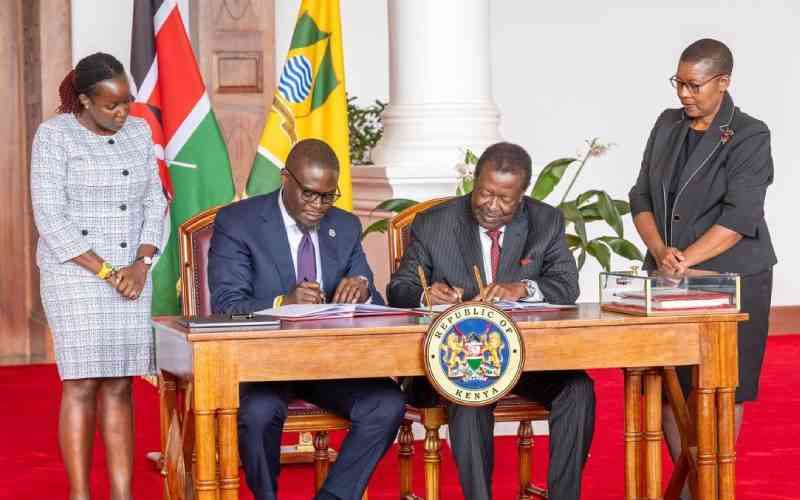
Johnson Sakaja has announced that Nairobi will now be governed under a two-tier leadership structure following the signing of a cooperation agreement with the national government.
Speaking on Tuesday, February 17, the Nairobi Governor said the new arrangement will introduce a Steering Committee and an Implementation Committee to coordinate the running of the capital.
Mudavadi to Chair Steering Committee
Under the new framework, the Steering Committee will be chaired by Prime Cabinet Secretary Musalia Mudavadi, with Sakaja serving as his deputy.
According to the governor, the committee will comprise Cabinet Secretaries and County Executive members and will be responsible for setting overall policy goals and strategic direction for the county.
“The Steering Committee, headed by the Prime CS and deputised by me, will comprise CSs and county secretaries. It will set the overall policy goals and direction of the County,” Sakaja said.
Sakaja to Head Implementation Committee
The Implementation Committee, chaired by Sakaja, will oversee the day-to-day execution of programmes and projects within Nairobi.
The governor explained that the committee will include Principal Secretaries and County Executive Committee members responsible for corresponding functions.
“The day-to-day execution of programmes and projects will be overseen by the Implementation Committee, which will be chaired by the governor of Nairobi. It will be comprised of PSs and County Executive Committee members responsible for the corresponding functions,” he revealed.
National Government to Reinforce Security
The agreement between Nairobi City County Government and the national government will also see the State step in to bolster security and restore order in the capital.
“This agreement solidifies these arrangements by providing additional support including partnerships in security and order, because we promised a city of order and dignity,” Sakaja stated.
Beyond security, the cooperation framework covers key sectors such as the Nairobi Rivers Commission, water provision, school feeding programmes, roads and mobility, markets, and housing.
The move signals deeper collaboration between City Hall and the national government in managing the capital’s development agenda.