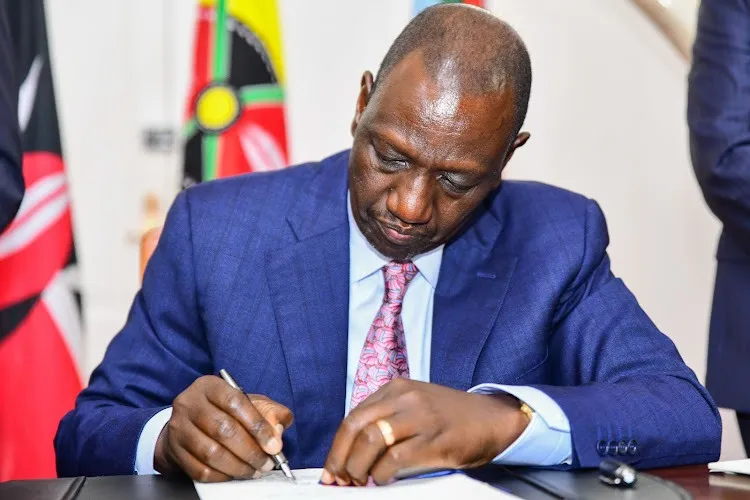
President William Ruto has signed three new Bills into law in a move aimed at strengthening disaster response systems, environmental conservation and equitable development across the country.
The laws were assented to during a ceremony held at State House, Nairobi, on Friday morning, marking the eighth presidential assent event of 2026.
The newly enacted laws are the National Disaster Risk Management Bill, 2023, the Forest Conservation and Management (Amendment) Bill, 2025, and the Equalisation Fund Appropriations Bill, 2025.
Speaking during the event, Deputy Chief of Staff in the Executive Office of the President, Josphat Nanok, said the legislation would improve institutional coordination and enhance service delivery in critical sectors.
The National Disaster Risk Management Act establishes a comprehensive legal and institutional framework to improve the country’s preparedness and response to disasters.
According to Nanok, the law creates the National Disaster Risk Management Authority alongside county disaster risk management committees tasked with coordinating disaster preparedness and emergency response efforts.
“It establishes a comprehensive legal and institutional framework for disaster risk management through the creation of the National Disaster Risk Management Authority and county disaster risk management committees,” Nanok said.
The law is expected to strengthen Kenya’s ability to anticipate, prepare for, respond to and recover from disasters, including floods, droughts, fires and other emergencies.
One of the key provisions in the new legislation gives the President powers to formally declare a national state of disaster where a coordinated national response is required.
The law also authorises the Head of State to direct emergency interventions, including mobilisation of resources and evacuation of affected populations, in efforts to protect lives and property during disasters.
The second law, the Forest Conservation and Management (Amendment) Act, 2025, introduces reforms aimed at strengthening forest governance and promoting sustainable management of forest resources.
Nanok said the legislation places greater emphasis on community participation in conservation efforts while also tightening regulatory oversight in the forestry sector.
“A seminal development introduced by the bill is the establishment of the Directorate of Forest Regulation,” he stated.
The new directorate will oversee compliance with forestry laws, license forest professionals and promote adherence to national forest management standards.
Meanwhile, the Equalisation Fund Appropriations Act, 2025, provides for the allocation of funds to marginalised counties in line with Article 204 of the Constitution.
According to the government, the law allocates Sh16.2 billion from the Equalisation Fund to 34 counties identified as marginalised by the Commission on Revenue Allocation under its Second Policy on Marginalisation.
“The Fund will support the implementation of critical development projects across designated constituencies within these counties,” Nanok said.
The funds are expected to support projects aimed at improving access to basic services and reducing regional inequalities in historically underserved areas.
The latest assent brings the total number of Bills signed into law by President Ruto in 2026 to eight, reflecting an active legislative agenda focused on governance reforms, environmental protection and equitable national development.