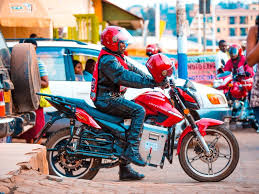
There are 100,000 motorbikes in Rwanda. The country wants to turn them all electric, and startups say their plans can make it work. Can green tech steer Africa towards the future?
Over the past decade, electric vehicles have been an integral part of the West’s planned transition to green energy, offering a variety of opportunities for carbon-hungry industries such as transportation, freight and logistics.
But outside of urban hubs in places like the US, the EU and east Asia, the promise of e-mobility is often harder to realise. In Africa, for example, widespread problems with power distribution are a serious roadblock for the adoption of electric vehicles. Rwanda, however, is thinking differently.
The tiny East African nation has a grand plan to convert its over 100,000 motorbikes to e-bikes. Officials know the project will put significant pressure on the country’s electricity grid, but a host of e-bike startups are experimenting with innovative solutions.
That includes solar-powered electricity stations, battery swapping plans, repurposing or recycling batteries as they wear down, and mini-grids (small, localised power generation systems that operate off-grid).
The aim is to power large e-bike fleets without interrupting its national electricity distribution. If it works, this could be a model for the rest of Africa and other corners of the developing world.
Rwanda’s greenhouse gas emissions were projected to double between 2015 and 2030, but interest in e-mobility exploded after the government pledged to reduce its rising emissions by 38% during the same period (approximately 4.6 metric tonnes).
Other African countries like Kenya, Togo, Nigeria and South Africa have rolled out assertive policies to promote their transition to clean energy – from subsidies on renewable energy to tax breaks and reduced import duties on electric vehicles.
Yet Rwanda is recording the most success, says Michael Irenge, an engineer based in the country who works at NETIS Group, a telecommunications and energy infrastructure firm. With cutting-edge renewable energy plans, a $300m (£226m) investment project to finance climate resilience, government incentives for electric vehicles and a host of enterprising e-bike startups, Irenge and others argue that Rwanda is helping to set new standards for African e-mobility.
E-bikes take centre stage
For several decades before Rwanda’s ambitious “Green Growth” pivot, gas-powered motorcycles were the norm – a staple even, as in many other African countries. This poses a problem. In 2021, the Rwandan National Gas Inventory Commission showed that taxi motorcycles alone contributed the equivalent of 427.45 gigagrams of CO2, making up 32% of the total emissions from road traffic.
Companies such as Ampersand, Spiro, eWaka and Rwanda Electric Motors (REM) say they have the solution. Startups have already sold, rented and leased thousands of these motorbikes (or “motars”, as they’re known in Rwanda) through cost-effective schemes, according to Toffene Kama, a Senegalese venture capitalist with investments in the electric vehicle industry.
“In many cases, the battery will be provided by the e-bike operating company which rents them out,” which makes the bikes more accessible by lowering upfront costs, Kama says. So far, their mission to push riders to switch from fossil fuel to electric vehicles has taken off on a broad scale, he says, thanks in large part to heavy support from the government.
On two major fronts, these startups are making progress. First, they’re helping the country cut down carbon emissions from road traffic, according to Josh Whale, chief executive of the e-bike company Ampersand. Whale says the bikes can eliminate a dramatic share of the annual greenhouse gas emissions you’d expect from a traditional motorcycle.