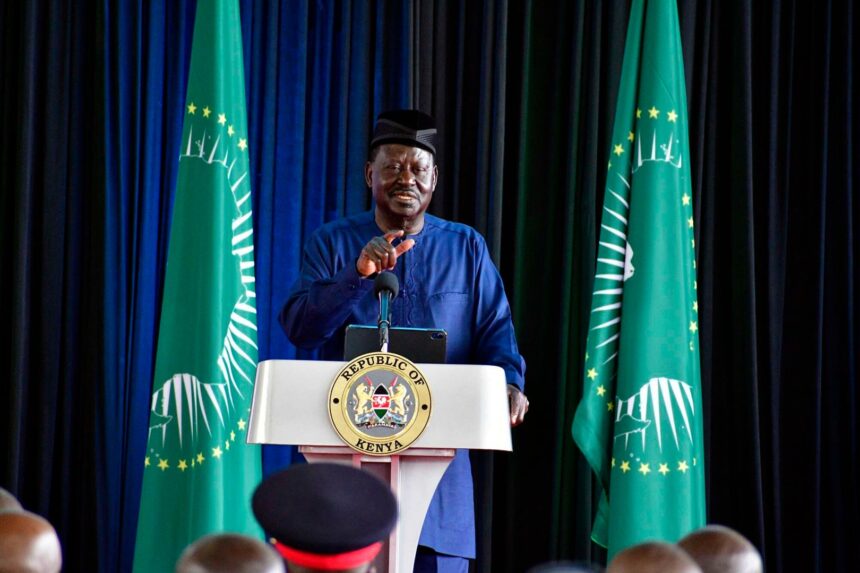
The Kenyan government quietly injected more than Ksh 523 million into ODM leader Raila Odinga’s failed bid for the African Union Commission (AUC) chairmanship, new budget records reveal.
A report by the Controller of Budget (CoB), Margaret Nyakang’o, has lifted the lid on the significant public expenditure, sparking widespread concern over government priorities and transparency.
Despite Kenya’s high-profile lobbying campaign—marked by President William Ruto’s presence and over 100 Members of Parliament at the February summit in Addis Ababa—Raila ultimately lost to Djibouti’s Mahmoud Ali Youssouf.
Now, scrutiny is mounting over the use—and possible misuse—of public funds in the process.
According to the National Government Budget Implementation Review Report for FY 2024/2025, Ksh 523.8 million was allocated by the National Treasury to the State Department for Foreign Affairs in November 2024 to finance the AUC campaign.
However, CoB records show that only Ksh 216.2 million was actually released from the Consolidated Fund in February 2025.
The report underscores the distinct roles of the Treasury and the CoB in public finance management: while Treasury, under Cabinet Secretary John Mbadi, approves budget allocations, actual disbursement requires authorization from the Controller of Budget.
That difference has raised more questions than answers. What became of the Ksh 307.6 million difference? Was the money withheld, canceled, or is it still pending disbursement?
The revelation comes amid rising public outcry over what many see as ballooning, non-essential government spending. Photos and media coverage from the AU summit portrayed an elaborate Kenyan delegation—complete with presidential aides, MPs, diplomats, and campaign operatives—which many believe reflected the scale and cost of the effort.
As pressure mounts, both citizens and lawmakers are demanding accountability and transparency on how public money was spent—and whether the cost was justified given the failed outcome.