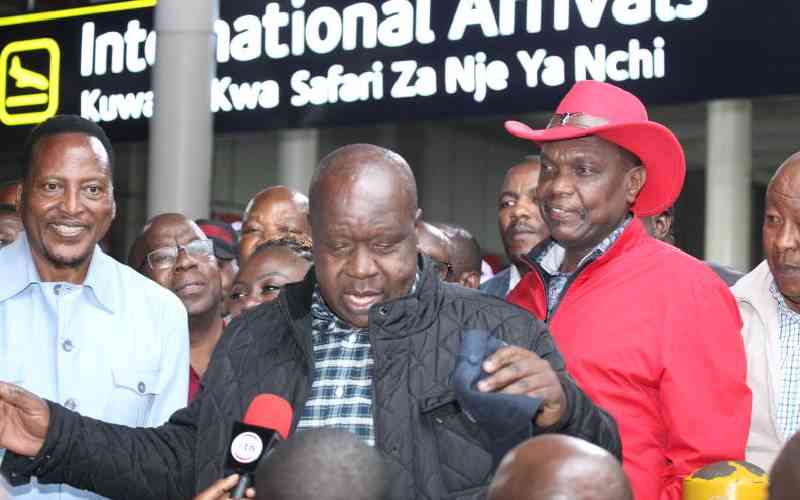
Nairobi, Kenya, September 23, 2025 — Kenya’s opposition is entering a decisive phase as leaders clash over how to choose their presidential flagbearer for the 2027 General Election. At the heart of the dispute is whether the opposition candidate should be picked based on voter strength or through a structured process guided by independent experts.
Gachagua Pushes for Numbers First
Speaking on Sunday, DCP Party Leader Rigathi Gachagua insisted that only a candidate with the ability to deliver millions of votes can stand a chance against President William Ruto.
“Those telling me to step aside must show me how many votes their preferred candidate brings to the table. In Mt Kenya alone, if everyone over 18 registers, we project 8.4 million votes. Should I surrender that to someone idling at home?” Gachagua challenged.
He argued that the opposition must not underestimate Ruto, who remains a formidable contender. “A second Ruto term is unimaginable. Unless we field a strong candidate with clear national appeal, we risk handing him a free pass,” he warned.
For context, recent IEBC voter registration data shows Mt Kenya remains one of the regions with the highest voting potential in the country.
Wamalwa Advocates for Expert-Led Process
In contrast, DAP-K Party Leader Eugene Wamalwa has pushed for a more measured approach. Speaking on Kameme TV, he revealed that the coalition plans to appoint a team of experts to guide the flagbearer selection.
“There is a lot to consider beyond raw numbers. Suitability will be assessed by professionals. Our opponents want us to reveal our candidate early, but strategy is about timing,” he explained.
The former Cabinet Secretary stressed that no single region can dethrone Ruto without a broad-based alliance. “Mt Kenya alone cannot do it. Unity across regions is our most lethal weapon,” Wamalwa said.
Criticism of Ruto’s Policies
Wamalwa also took aim at Ruto’s economic policies, terming them “Rutonomics,” which he said had destroyed livelihoods.
“Just like Liberia’s George Weah or Nigeria’s Goodluck Jonathan, Ruto risks being a one-term president because of economic mismanagement,” he argued.
For more insights on how Kenya’s economy is faring under Ruto, see our report on Kenya Kwanza economic policies.
Kalonzo, Matiang’i and the Wider Coalition
Other senior opposition figures — including Kalonzo Musyoka of Wiper and Fred Matiang’i — remain central to coalition talks. However, political analyst Javas Bigambo has cast doubt on their presidential viability.
“Matiang’i has not campaigned outside Kisii. As for Kalonzo, his history of stepping down for Raila Odinga weakens his credibility as a flagbearer,” Bigambo noted in an analysis quoted by The Standard.
Still, Gachagua praised Kalonzo’s efforts in consolidating the Ukambani vote, saying he is among the few opposition leaders actively building grassroots support.
Coalition Still Struggling with Identity
Beyond candidate selection, the opposition has yet to agree on a coalition name that resonates with Kenyans. Insiders say several options are under review, but none has been settled on.
Unity or Collapse Ahead of 2027?
With five presidential hopefuls and at least two possible running mates in the fold, the opposition is juggling competing ambitions. Both Gachagua and Wamalwa have expressed willingness to step aside, but only if a rival demonstrates a credible plan to beat Ruto.
“This is a sacred duty. We will unite behind whoever is chosen,” Wamalwa said, even as Gachagua maintained that numbers will ultimately decide.
Analysts warn that unless the coalition finds a balance between strategy and voter arithmetic, it risks repeating past failures of opposition outfits that collapsed under the weight of personal ambitions.