When young Kenyans organized online against a set of tax hikes in mid-2024, few expected the campaign to reshape the country’s politics and its courts.
What began as a digital-first movement to #RejectFinanceBill2024 quickly became a nationwide uprising — and then a test of Kenya’s democratic institutions after protesters were met with deadly force, disappearances and, ultimately, a High Court judgment that condemned the state’s conduct.
From #RejectFinanceBill2024 to the streets
The protests were born on social media. Gen Z activists used TikTok, X (formerly Twitter) and Instagram to mobilize thousands of young people who objected to steep proposed taxes on essentials such as bread, cooking oil and mobile money transfers.
The online campaign spilled into the streets in June 2024, drawing massive demonstrations in Nairobi and other cities as youth-led gatherings demanded
lawmakers withdraw the offending measures.
Observers noted the movement was largely leaderless, decentralized and digitally coordinated.
Tensions peaked on 25 June 2024, when hundreds — then thousands — of demonstrators broke through police lines and entered the parliamentary precinct in
Nairobi. Part of the complex was set alight.
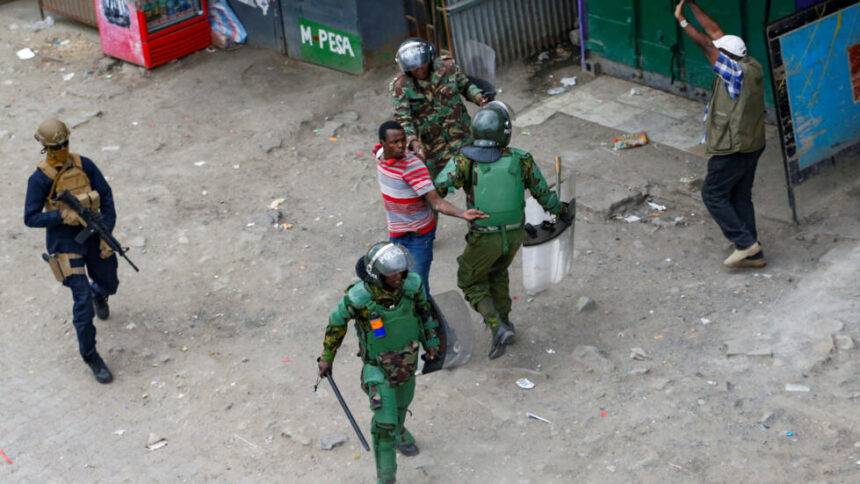
Security forces fired live rounds, rubber bullets and teargas at crowds, and the confrontation left multiple people dead and many more wounded.
Within days President William Ruto announced he would not sign the Finance Bill, but the damage — and the public demand for accountability — had already grown beyond the tax dispute.
Abductions, deaths and masked officers
In the chaos that followed, a disturbing pattern emerged: young people were rounded up, bundled into unmarked vehicles and in some cases never seen again.
Eye-witnesses, NGOs and later investigations reported that masked and hooded men in civilian clothes — later shown in several accounts to include police officers operating without visible identification — were involved in abductions and painful, sometimes fatal, custody episodes.
Amnesty and other rights groups documented instances in which plain-clothes officers fired live ammunition at protesters.
The Independent Policing Oversight Authority (IPOA) monitored the protests and early on warned that police tactics had ranged from restrained crowd control to unlawful uses of force.
IPOA’s monitoring and subsequent investigations found police had used live ammunition, rubber bullets and teargas; that officers sometimes concealed badges and vehicle numbers; and that teargas was fired even at makeshift medical camps established at locations such as Jamia Mosque and the Holy Family Basilica.
IPOA reported opening dozens of files — including investigations into 59 deaths and 234 injuries allegedly linked to police action — and forwarded completed files to the Director of Public Prosecutions where appropriate.
These practices struck at the very core of democratic policing: if law enforcement cannot be identified while performing core functions, accountability is frustrated and public trust evaporates.
IPOA and later judicial findings emphasized that there is no lawful basis in the Police Standing Orders or the National Police Service Act that permits officers to hide their identities, mask their faces or use unmarked vehicles to detain citizens during demonstrations.
The petition that put the state on trial
Outrage over the disappearances and killings culminated in a constitutional petition filed on 24 June 2024 by Saitabao Ole Kanchory.
The petition named the Inspector-General of Police, the Cabinet Secretary for Interior, and the Attorney General as respondents, and asked the court to declare a range of police practices unconstitutional — from the use of water cannons, live ammunition and teargas on peaceful demonstrators, to the deployment of armed officers in civilian clothes and unlawful abductions.
It also asked the court to compel IPOA to investigate and recommend prosecutions where warranted. (The Law Society of Kenya and the Kenya National Commission on Human Rights were listed as interested parties).
The State’s defence insisted protest rights are not absolute and argued that police actions responded to pockets of violence, property destruction and attempts to overpower officers.
The Government maintained that where force was used it was within legal bounds and at times necessary to protect life and property.
IPOA’s own affidavit struck a middle ground: it confirmed instances of excessive force and identification failures by police, acknowledged isolated protestor violence and damage to property, but emphasized that the use of live ammunition to disperse assemblies is unlawful and that many police actions violated standing orders and international guidelines.
IPOA further told the court it had opened dozens of investigations and forwarded completed files to the DPP.
The High Court: clear declarations
On 30 September 2025, the High Court (sitting in Malindi) delivered a clear, constitutional rebuke and judgement.
Justice M. Thande issued two principal declarations: first, that the use of water cannons, tear gas, rubber bullets, live ammunition and brute force against persons exercising their Article 37 rights to assemble and protest is illegal, unconstitutional and unacceptable; second, that extrajudicial killings, abductions, arbitrary arrests, torture and degrading treatment of protesters are gross violations of the Constitution.
The court noted these findings in the context of both the NPS regulatory framework and the supreme law of the land.
The judgment highlighted a critical administrative and constitutional point: police are public servants obliged to be identifiable and to uphold the highest standards of professionalism under Article 244 and the standing orders.
The ruling further drew attention to Chapter 31 of the National Police Service Standing Orders, which allows limited plain-clothes deployment for certain units (DCI, Internal Affairs, VIP protection, Crime Branches) but contains no authorization for officers to be hooded, masked or to conceal vehicle registration when policing demonstrations.
While issuing the judgement, the judge used stark language: the behaviour of hooded, masked officers and vehicles without numbers “militated against” the constitutional imperative of transparency and accountability and was “totally unacceptable in a civilized, open and democratic society.”
Finally, the court declined to award legal costs to the petitioner, reasoning the case was a matter of public interest and that imposing costs on the state would unduly burden taxpayers. Each party was ordered to bear its own costs.
What the ruling means — and what it does not yet do
The judgment is a powerful statement of constitutional values and a significant legal precedent: it expressly limits the circumstances in which police may use force against assemblies, stresses the duty of identification and accountability, and affirms IPOA’s oversight role. Civil society hailed the ruling as a vindication of citizens’ rights and a rebuke to a culture of impunity.
But the decision stops short of immediate criminal prosecutions or specific remedies for individual victims.
IPOA’s investigations and the DPP’s prosecutorial decisions remain the mechanisms through which individual accountability must be pursued; human rights defenders caution that prosecutions and internal disciplinary outcomes will be the true test of whether the ruling changes conduct on the ground.
IPOA itself has already referred some investigation files to the DPP and continues to probe dozens more.
For families still searching for answers about missing relatives, the court’s declarations provide moral and legal validation — but many will say they await concrete action: arrests, trials, and reparations.
As for the police service, the ruling is a clear order to reform: ensure transparency, keep officers identifiable, avoid unlawful force and respect the constitutionally protected rights of assembly and expression.