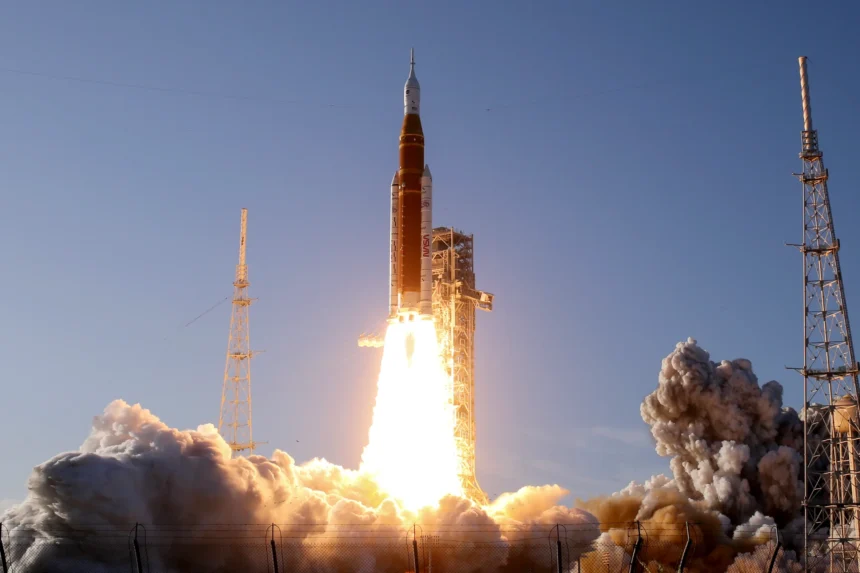
Humanity’s long-awaited return to deep space has taken a decisive step forward, with NASA’s Artemis II crew now orbiting Earth aboard the Orion spacecraft—marking the first crewed mission of the Artemis programme.
The four astronauts—Commander Reid Wiseman, pilot Victor Glover, mission specialist Christina Koch, and Jeremy Hansen—are currently about 42,500 miles (68,000 km) from Earth, carrying out critical tests that will determine whether the spacecraft is ready for deeper space travel.
The mission, part of NASA’s broader Artemis program, is designed to pave the way for future lunar landings, including the ambitious goal of returning humans to the Moon later this decade.
Testing Orion in Real Conditions
Shortly after launch, Orion’s solar arrays deployed successfully, providing the power needed to sustain the spacecraft. Roughly the size of a minibus, Orion is being flown with a human crew for the first time, making this phase of the mission crucial.
Victor Glover is leading efforts to push the spacecraft’s systems to their operational limits, while the crew collectively evaluates navigation, propulsion, and onboard life-support systems. NASA engineers are closely monitoring every detail to ensure the spacecraft can safely handle the harsh conditions of deep space—where emergency returns are far more complex than in low-Earth orbit.
As an added layer of safety, the astronauts are equipped with specially designed suits capable of sustaining them for up to six days in the event of a critical system failure.
Life in Orbit: Strict Schedules and Small Comforts
Unlike the early days of the Apollo program, Artemis II is being broadcast live, offering the public an unprecedented window into life aboard a spacecraft.
Cameras show astronauts running system checks, documenting their journey on mobile devices, and communicating with Mission Control. Even small moments—like Wiseman jokingly requesting “comfort garments” before sleep—highlight the human side of the mission.

Life onboard is tightly structured. The crew follows a rigorous schedule, with sleep broken into intervals of about four hours at a time. Sleeping itself is an adjustment, requiring astronauts to strap into floating sleeping bags in a zero-gravity environment.
Daily exercise is mandatory to counteract the effects of microgravity on muscles and bones. Using a compact flywheel-based device, the astronauts perform routines including rowing, squats, and resistance training.
Meals are equally engineered for space. With no refrigeration onboard, most food is freeze-dried and rehydrated with water. The menu—customised in advance—includes options such as macaroni and cheese, beef brisket, and a variety of hot sauces. Drinks are limited, but include coffee and nutritional beverages.
Even basic systems like the onboard toilet have been tested under pressure. After initial concerns during launch, Mission Control confirmed the system is now fully operational.
The Critical Push Toward the Moon
The mission’s next major milestone is the “trans-lunar injection”—a powerful engine burn that will propel Orion out of Earth’s orbit and onto a trajectory toward the Moon.
If successful, the manoeuvre will send the spacecraft on a looping path around the Moon, using its gravity to slingshot the crew back toward Earth. This approach mirrors strategies used during Apollo missions but incorporates modern navigation and safety systems.
At its peak, Artemis II is expected to travel approximately 6,400 miles (10,299 km) beyond the Moon’s far side—the most distant point humans have ever travelled from Earth.
The astronauts will observe and photograph regions of the Moon that are never visible from Earth, contributing valuable data to ongoing lunar research. While robotic missions from countries like India and China have previously mapped parts of this terrain, Artemis II will be the first time humans directly witness these areas.
A Stepping Stone to Lunar Landing
Although Artemis II will not land on the Moon, its success is critical for future missions—particularly Artemis III, which aims to return astronauts to the lunar surface for the first time since the Apollo era.
NASA’s long-term vision extends beyond the Moon, with Artemis serving as a testing ground for technologies and systems needed for eventual missions to Mars.
For now, all eyes remain on Orion and its crew as they push the boundaries of human spaceflight once again—reviving a journey that began more than half a century ago, and setting the stage for a new era of exploration.