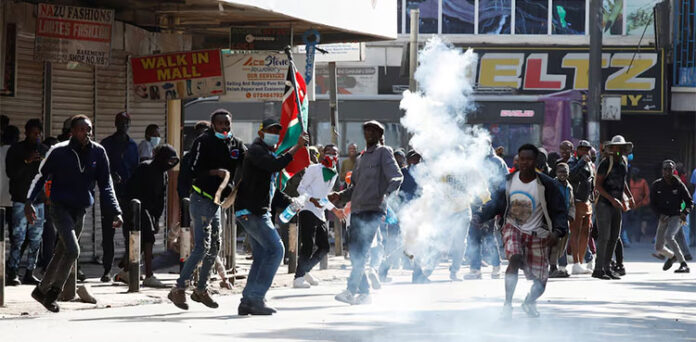
Kenya woke up to heightened security, road closures, and an unprecedented media blackout on Wednesday as the country marked the first anniversary of the deadly anti-Finance Bill 2024 protests.
The day, which activists, opposition leaders, and youth movements had dubbed “Youth Transparency Day,” was intended to honour the memory of at least 60 people killed during last year’s violent demonstrations and to press for accountability from the state.
In Nairobi, heavy police presence was evident as key access roads to the Central Business District (CBD) were sealed off by dawn.
Major routes such as Jogoo Road were barricaded at City Stadium, forcing commuters to walk the rest of the way.
All approaches to State House and Parliament were fortified with razor wire and heavily armed officers.

Parliament buildings, in particular, were placed on lockdown overnight, and by midmorning, several MPs were seen being discreetly driven out in SUVs as protesters gathered nearby.
Interior Cabinet Secretary Kipchumba Murkomen arrived at Harambee House before sunrise to oversee security operations, flanked by senior officials including Inspector General of Police Douglas Kanja and DCI Director Amin Mohamed.
Addressing the nation a day earlier, Kanja had warned demonstrators to avoid restricted areas and pledged that officers would act “within the law to protect lives and property.”
Parliament adjourned
Inside Parliament, business ground to a halt by 11:30 a.m. due to a lack of quorum, with lawmakers abandoning their seats as protesters engaged police in running battles outside.
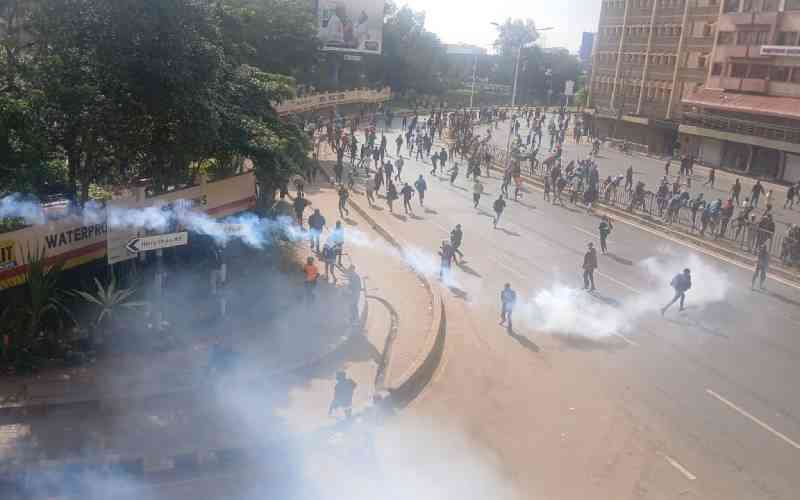
Similar scenes unfolded in other towns including Mombasa, Eldoret, Nakuru, Homa Bay, Machakos, Nyeri, Laikipia, Narok, Kakamega, Busia, and Kirinyaga, where thousands took to the streets, paralyzing business operations.
Remarkably, Kisumu—a city historically known for political protests—remained largely calm.
Shops stayed open and public service vehicles continued operations uninterrupted in areas like Kondele, Kachok, and the main bus park, a subdued atmosphere standing in contrast to the day’s nationwide unrest.
Government Orders Media Blackout
In a controversial move, the Communications Authority of Kenya (CAK) issued a directive to all television and radio stations ordering an immediate halt to live coverage of the protests.
In a memo dated June 25, CAK Director-General David Mugonyi cited Articles 33(2) and 34(1) of the Constitution and Section 46I of the Kenya Information and Communications Act (1998) as legal grounds for the ban.
“The live coverage of the June 25th, 2025 demonstrations is contrary to the law,” Mugonyi wrote, warning that failure to comply would result in regulatory sanctions.
While the authority did not specify the nature of potential penalties, it made clear that full compliance was expected.
The move drew sharp criticism from civil society groups and international observers, who accused the government of attempting to stifle dissent and suppress press freedom.
Violence and Casualties Reported
Despite calls for peaceful demonstrations from both activists and authorities, clashes erupted in parts of Nairobi as police fired tear gas and rubber bullets to disperse crowds.

Notably, former Chief Justice David Maraga, Kalonzo Musyoka, and Senator Okiya Omtata joined the demonstrators and were among those teargassed during a march through the city centre.
Several protesters sustained injuries, with reports of gunshot wounds and blunt force trauma. By noon, videos circulating online showed wounded individuals being rushed into Kenyatta National Hospital (KNH) for emergency treatment.
One protester was seen with severe facial injuries, reportedly caused by a tear gas canister.
Although the exact number of casualties remained unclear by press time, at least five injured demonstrators had been brought to KNH while others were ferried to hospitals across the city.
A Day of Remembrance and Defiance
The protests were organised to commemorate the victims of the June 25, 2024 demonstrations and to renew calls for justice, fiscal accountability, and police reform.
Organisers had planned peaceful vigils, rallies, and public speeches, with activists insisting that the struggle for transparency and human rights remains unfinished.
Security forces, meanwhile, deployed helicopters to monitor crowds from the air as heavily armed riot police maintained a tense stand-off with demonstrators on the ground.
While authorities maintained their position on upholding public order, protesters expressed determination to defy intimidation and continue pressing for reform.
“We are here to honour those we lost and to demand the Kenya we deserve,” one young protester shouted as police advanced along Kenyatta Avenue.
As of late afternoon, Nairobi remained on edge with running battles continuing in some areas, while business activity in most towns remained partially disrupted.