On 29 October 2025, Tanzania held its presidential, parliamentary and local-council elections, which were expected to be walk in the park for the incumbent, President Samia Suluhu Hassan.
But what began as a routine democratic ritual has erupted into full-scale street protests, a militarised response, and a resounding victory for the ruling party — all against a backdrop of suppressed opposition.
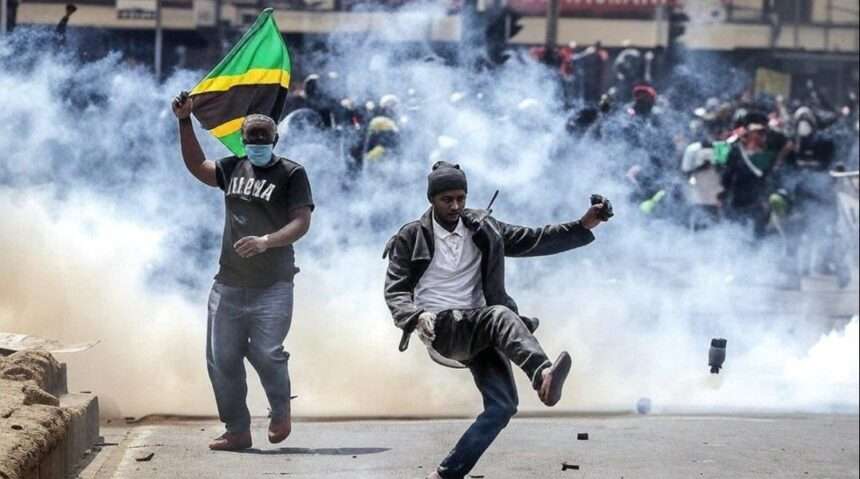
According to the Associated Press, the trouble began as hundreds of protesters in the Kimara and Ubungo neighborhoods of Dar es Salaam took to the streets, setting a bus and a gas station ablaze.
The unrest soon spread to other neighborhoods, including Magomeni, Kinondoni, and Tandale, with similar scenes reported in districts outside the capital of Dodoma, such as Arusha and Mbeya.
Demonstrations even reached the border town of Tunduma, a border town in Tanzania, located on the Tanzanian-Zambian border.
The government responded swiftly and forcefully. Inspector General of Police Camillus Wambura announced a 6 p.m. curfew in Dar es Salaam, urging residents to stay indoors.
The military was deployed not only in the capital but also in Dodoma and the semi-autonomous region of Zanzibar, including along streets housing major media organizations.
“Security agencies are ready to deal with any disruptors of peace,” regional commissioner Albert Chalamila.
Amid the chaos, internet connectivity across Tanzania ground to a halt. NetBlocks, a global internet monitor, described the situation as a “nationwide digital blackout,” corroborating widespread reports of restricted online access.
The state-run Tanzania Broadcasting Corporation began airing the announcement of provisional election results, which showed Hassan winning commanding majorities in various constituencies.
Snapshot of the situation so far
Below is a snapshot of what has happened so far:
- According to multiple sources, scores of protesters clashed with police in major cities including Dar es Salaam and Mwanza, with reports of live gunfire, tear gas, burning vehicles and barricades.
- A curfew was imposed in Dar es Salaam, the commercial capital, and the military was deployed on the streets.
-
The country experienced an internet disruption/blockdown, hampering communications and raising concerns among human-rights observers.
-
Early tallies from the Independent National Electoral Commission (INEC) showed the incumbent, Samia Suluhu Hassan, securing overwhelming leads — including almost 95 % in one region.
-
Major opposition figures and parties were barred or otherwise prevented from meaningful participation in the election.
-
European Union (EU) lawmakers called the election a “fraud” that had been “unfolding for months”.
- The British government said international flights had been cancelled to and from Dar es Salaam’s airport and that the airport in Arusha and one near Mount Kilimanjaro were closed.
-
The U.S. Embassy advised its citizens to shelter in place, warning that travelling by road posed significant risks and that many international flights had been cancelled.
Why many are calling the vote a sham
Opposition under siege
The leader of the country’s main opposition party, Tundu Lissu of CHADEMA, has been charged with treason over a speech urging “No Reform, No Elections”. The trial opened in early October.
Because CHADEMA refused to sign a mandatory code of ethics, the party was barred from the election.
Meanwhile the second-largest opposition, ACT‑Wazalendo, saw its candidate Luhaga Mpina disqualified on technical grounds.
The ruling party, Chama cha Mapinduzi (CCM), has governed Tanzania since its independence in 1961 and has never lost an election. With the main opposition effectively sidelined, many analysts say this election offered almost no genuine alternative.
A harsh response to protests
Rights groups say at least two people — a civilian and a police officer — were killed during the clashes. Amnesty International has called the deaths “deeply disturbing”.
In the border town of Namanga (on the Tanzania/Kenya border), protesters spilled into Kenyan territory, blocking roads and lighting bonfires as Kenyan authorities warned citizens not to join the protests.
What changed since 2021?
When Samia Suluhu Hassan took office in 2021 (after the death of her predecessor, John Magufuli), there were hopes of a move toward more open politics.
But by 2025, political space had narrowed. Thousands of activists and critics have alleged abuse, enforced disappearances and crackdowns.