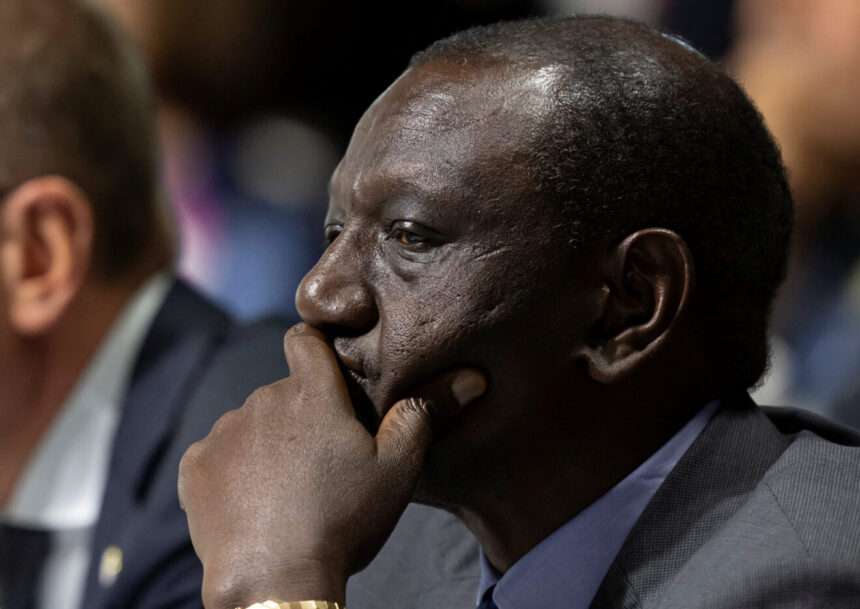
The High Court in Nairobi has quashed President William Ruto’s Executive Order No. 3 of 2024, which had introduced new guidelines on the management and terms of service for board members and staff of State corporations.
Justice Lawrence N. Mugambi, sitting at the Milimani Law Courts, declared the Executive Order and its accompanying guidelines unconstitutional, terming them an unlawful encroachment on the mandate of the Public Service Commission (PSC) as enshrined under Article 234 of the Constitution.
The case, filed by the Law Society of Kenya (LSK) against the State Law Office, Salaries and Remuneration Commission, and others, challenged the legality of the President’s move to centralize control over State corporations through the Office of the President and the State Corporations Advisory Committee (SCAC).
LSK through Oira and Bosire advocates moved to court last year after the government issued the Executive Order No.3 which provided among others , terms and conditions of service for boards and human resource management of State corporations
Court’s Findings
In his detailed judgment delivered on November 7, 2025, Justice Mugambi ruled that Sections 5(3) and 27 of the State Corporations Act, which the Executive Order had relied upon, are unconstitutional for conflicting with the Constitution’s provisions on the PSC’s powers.
“The authority to develop and recommend guidelines on management of terms and conditions of service in the public service is vested on the Public Service Commission,” the judge declared, adding that any delegation of this authority must be in writing as required under Article 234(5) of the Constitution.
The Court further found that the Cabinet Secretary for the National Treasury had no authority to perform functions reserved for the Salaries and Remuneration Commission (SRC) under Article 230 of the Constitution.
Consequently, Justice Mugambi issued an order of certiorari quashing the entire Executive Order No. 3 of 2024 and the impugned guidelines, declaring them invalid, null, and void. No costs were awarded, as the petition was deemed a public interest matter.
Background of the Case
The controversial guidelines were published through Gazette Notice No. 6265 of May 24, 2024, directing all State corporations and Cabinet Secretaries to implement uniform terms and conditions for their boards and staff.
The move was seen as part of President Ruto’s push to streamline governance and curb what he termed “wastage” in parastatals.
However, the Law Society of Kenya argued that the guidelines undermined the constitutional independence of the PSC and the SRC, transferring their powers to the Executive without legal backing.
The society also faulted the process for lacking public participation and parliamentary approval, as required by the Statutory Instruments Act.
The PSC, which joined the case as the third respondent, supported LSK’s position, saying it had not approved the guidelines and had warned the Office of the President of their unconstitutionality before they were launched in June 2024.
Significance of the Ruling
The decision is widely viewed as a major setback to President Ruto’s efforts to tighten control over State corporations, which have historically operated under varying management frameworks. It reaffirms that all public bodies — including State corporations and public universities — fall under the oversight of the Public Service Commission.
The ruling also reinforces the doctrine of separation of powers and the independence of constitutional commissions, warning the Executive against overstepping legal boundaries in the name of policy reform.
In his concluding remarks, Justice Mugambi emphasized that legality and constitutionalism remain the cornerstone of governance in Kenya:
“Public bodies, no matter how well-intentioned, may only do what the law empowers them to do. The essence of legality is that public power can only be validly exercised if it is clearly sourced in law.”
What Next
The ruling is expected to force the government back to the drawing board in reforming State corporation management.
It also places renewed responsibility on the PSC to provide leadership and guidance in setting service terms across the public sector, in line with constitutional mandates.
As of Friday, the Office of the President had not issued a formal response to the ruling. However, legal observers say the decision could have ripple effects across ministries and parastatals that had begun implementing the now-nullified guidelines.