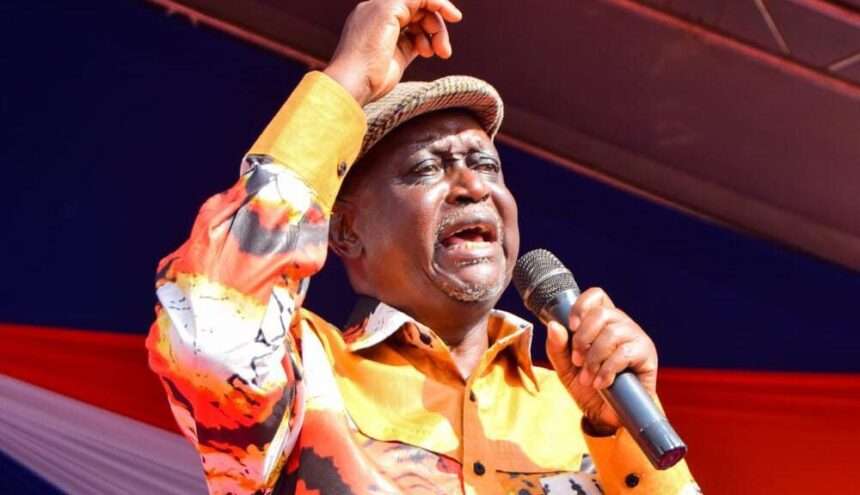
Orange Democratic Movement (ODM) leader Oburu Onginga has pushed back against growing calls to remove party-linked officials serving in President William Ruto’s administration, arguing that such demands offer no tangible benefit to the Nyanza region.
Speaking during a meeting with religious leaders in Nyanza on Friday, Oburu dismissed critics urging the dismissal of ODM-affiliated figures in government, saying the country belongs to all Kenyans and not a select group.
“Kenya is not yours Kenya is for everybody so I am telling those who are demanding the sacking of our people who are in government to shut up,” said the ODM leader.
He questioned the logic behind the calls, asking whether those pushing for the removals would secure replacements from the same region if the officials were ousted.
The ODM leader used the forum to defend party members currently under public scrutiny, suggesting the criticism is politically driven rather than grounded in accountability.
His remarks come amid mounting pressure on Energy Cabinet Secretary Opiyo Wandayi over an alleged Ksh. 4.8 billion fuel scandal.
Oburu has previously dismissed calls for Wandayi’s removal, terming them a political witch hunt.
In an earlier statement, he warned that targeting cabinet secretaries such as Opiyo Wandayi and Trade CS Lee Kinyanjui – who are not accounting officers – risks derailing investigations and politicising the matter further.
Both Wandayi and Kinyanjui have faced scrutiny over alleged links to the controversial importation of fuel, a situation that has fueled public anger and intensified political debate.
Meanwhile, former United Nations Conference on Trade and Development Secretary-General Mukhisa Kituyi has raised fresh concerns over the Government-to-Government (G-to-G) oil import arrangement.
He argues that the deal appears skewed to benefit a few individuals instead of stabilising fuel prices for ordinary Kenyans.
Kituyi pointed to structural weaknesses in the agreement, saying it has failed to shield the country from global shocks such as disruptions linked to conflict in the Gulf region.
He proposed that the National Oil Corporation of Kenya should take over fuel importation, rather than leaving it to private Oil Marketing Companies, to better regulate price fluctuations.
Amid the criticism, President Ruto has defended Kenya’s fuel pricing, attributing it to the country’s classification as a lower-middle-income economy.
Speaking during a church service on April 19, he urged Kenyans to compare fuel prices with countries of similar economic standing rather than neighbouring states classified as least developed.
Fuel costs in Kenya remain high, partly due to a range of statutory charges. Petroleum products are subject to multiple taxes and levies, including Value Added Tax, excise duty, the Road Maintenance Levy, Petroleum Development Levy, Petroleum Regulatory Levy, Railway Development Levy, Anti-Adulteration Levy, Merchant Shipping Levy, and the Import Declaration Fee.