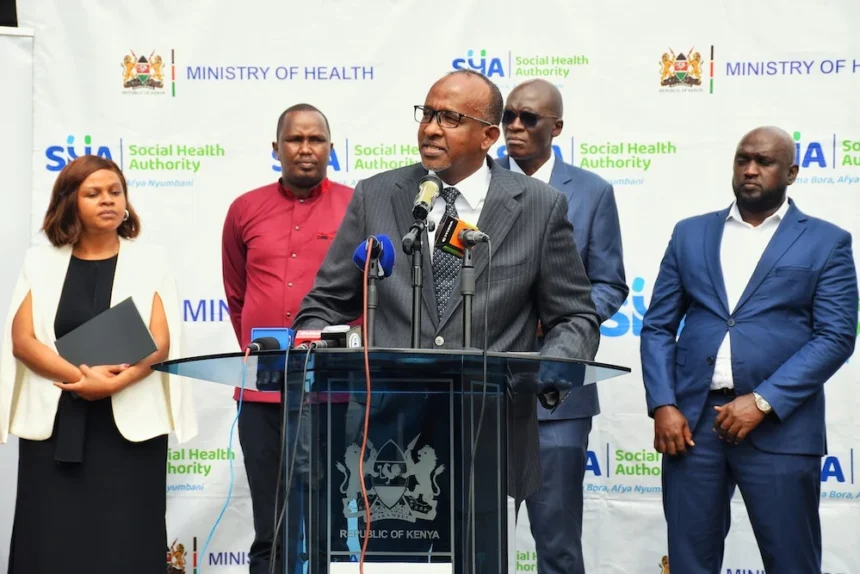
Health Cabinet Secretary Aden Duale has defended the government’s decision to establish a health facility in Laikipia in partnership with the United States, dismissing claims that the centre is being set up exclusively to host Americans exposed to Ebola.
Speaking during an interview, Duale said the planned facility is a military installation designed to serve both Kenyan and American nationals, particularly personnel operating in regions considered high-risk for infectious disease outbreaks.
According to the CS, the project is part of Kenya’s broader strategy to strengthen preparedness and response capabilities against potential public health threats.
Facility Not Intended to Import Ebola Patients
Duale sought to address growing public concern surrounding the project, insisting that the facility is aimed at enhancing Kenya’s health security infrastructure rather than bringing Ebola patients into the country.
“Why is it said we’re bringing Ebola patients to Laikipia? The facility is a military facility. KDF soldiers and other Kenyans will use that facility,” he said.
The Health CS noted that many Kenyans, including members of the Kenya Defence Forces, work in regions where Ebola outbreaks have previously occurred.
He pointed out that hundreds of Kenyan peacekeepers are currently deployed in the Democratic Republic of the Congo under United Nations missions, making preparedness an important national security and health concern.
US Support Has Strengthened Kenya’s Health Sector
Duale also defended Kenya’s long-standing partnership with the United States in the health sector, noting that American support has contributed significantly to healthcare development since independence.
He stated that the latest cooperation agreement between Kenya and the US is valued at approximately KSh206 billion and will support improvements in disease surveillance, healthcare infrastructure and emergency response systems.
The CS further highlighted the role of Kenya Medical Research Institute, saying international partnerships have helped Kenya build some of the strongest laboratory and surveillance systems in the region.
Government Establishing Multiple Isolation Centres
According to Duale, the Laikipia facility is only one component of a wider national Ebola preparedness programme.
He revealed that the government is establishing 11 quarantine, isolation and treatment centres across the country as a precautionary measure.
The location in Laikipia was selected partly because it is situated away from densely populated urban centres, making it suitable for emergency isolation and response operations if required.
“There is nothing shrouded about this Ebola quarantine process. We are putting in place 11 quarantine, isolation and treatment centres across the country as a safety measure just in case we get affected. It is our duty to ensure Kenyans are protected,” he said.
Over 1,000 Health Workers Trained
The Health CS disclosed that the government has already established an Incident Management Centre and an Emergency Response Centre in Nairobi to coordinate preparedness efforts.
He added that more than 1,000 healthcare workers have undergone specialised training on Ebola detection, prevention and response protocols.
Duale further revealed that 16 individuals have so far been tested for Ebola in Kenya, with all samples returning negative results.
Kenya Remains Ebola-Free
The remarks come amid heightened regional vigilance following Ebola outbreaks reported in neighbouring countries.
The Ministry of Health maintains that Kenya has not recorded any confirmed Ebola cases.
Authorities have intensified screening at border points, strengthened disease surveillance systems and expanded emergency response capacity as part of efforts to prevent the virus from entering the country and to ensure rapid containment should a case be detected.