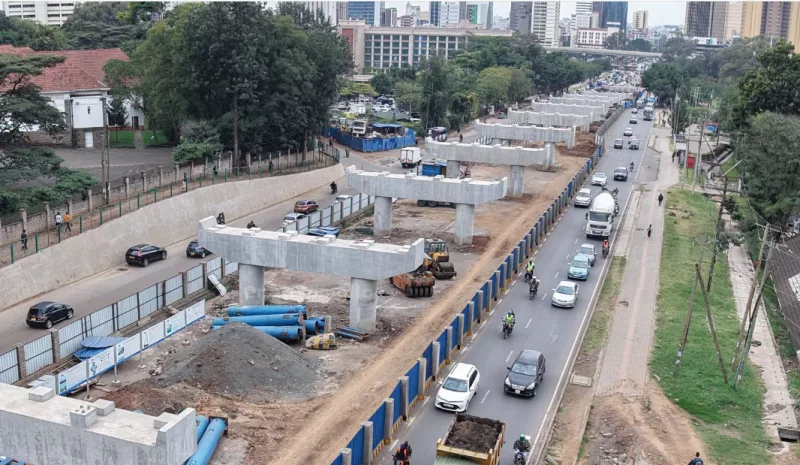
The Sh3 billion Upper Hill–Kenyatta Avenue Viaduct has reached 60 per cent completion, marking a key milestone in one of Nairobi’s flagship road infrastructure projects aimed at easing traffic congestion and improving access to the city’s commercial districts.
The Office of the Government Spokesman announced the progress in a statement shared on its social media platforms, saying construction of the elevated roadway near All Saints Cathedral is steadily advancing.
“Once completed, the project will significantly improve access to Nairobi’s Central Business District (CBD) and help ease traffic congestion,” the office said.
The viaduct is designed to provide a direct link between Nairobi’s Central Business District and the Upper Hill commercial hub, enabling motorists to bypass some of the city’s busiest intersections that have long been associated with heavy traffic delays.
The elevated road stretches along Kenyatta Avenue from the Integrity Centre to the Serena Hotel and forms part of a broader road improvement programme that also includes the Upper Hill–Haile Selassie Overpass and the Valley Road–Kenyatta Avenue/Ngong Road/Nyerere Road Interchange.
Once operational, the corridor is expected to significantly reduce travel times for thousands of motorists accessing Upper Hill, home to numerous government offices, corporate headquarters, financial institutions and diplomatic missions.
Construction is being undertaken by China Road and Bridge Corporation (CRBC), with works progressing in phases to minimise disruption to motorists while maintaining safety and engineering standards.
The project has faced several setbacks since construction began in September 2020.
Works stalled for years following payment disputes involving the contractor, leading to prolonged delays and criticism from road users affected by traffic congestion and construction-related disruptions.
Construction resumed in July 2025 after the government secured funding under President William Ruto’s administration, enabling the contractor to return to the site and accelerate implementation.
The government is now targeting completion and opening of the viaduct to motorists before the end of 2026.
According to the Kenya Urban Roads Authority (KURA), the delays were largely due to the technical complexity of the project, particularly the installation of massive support columns and steel structural components required for the elevated roadway.
The authority said the project involves precision engineering that must be executed in carefully planned phases to ensure the flyover’s long-term safety, stability and durability.
The Upper Hill–Kenyatta Avenue Viaduct forms part of the government’s wider strategy to modernise Nairobi’s transport network through the construction of grade-separated interchanges and elevated roads aimed at improving mobility, reducing congestion and supporting the city’s growing commercial activities.