Former Prime Minister Raila Amollo Odinga has been laid to rest at his family home in Kang’o ka Jaramogi, Bondo, Siaya County, in a solemn ceremony attended by thousands of mourners and top state officials.
The burial marked the end of a week of national mourning for the veteran opposition leader, who was accorded full military honours by the Kenya Defence Forces (KDF) in accordance with a presidential proclamation by President William Ruto.
A Historic Military Send-Off
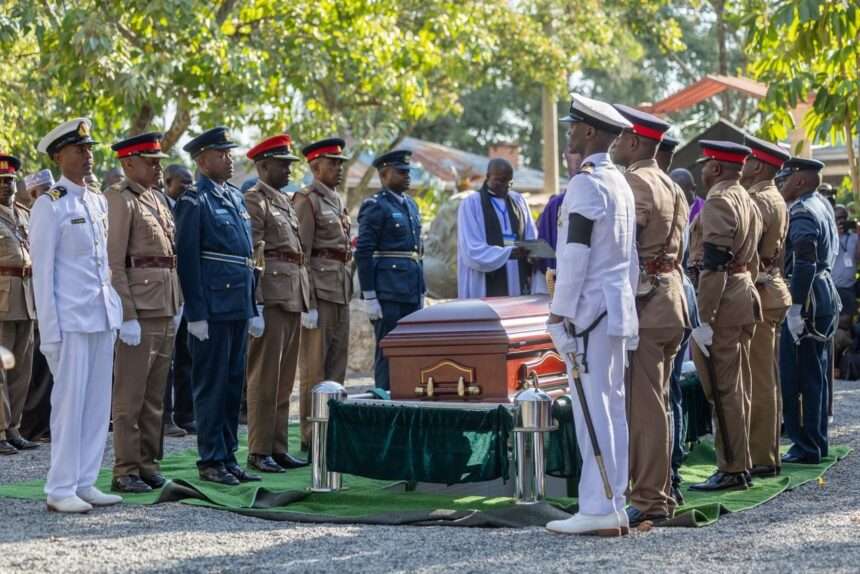
Raila’s casket, draped in the Kenyan flag, lay under tight military guard as family, dignitaries, and ordinary citizens gathered at the ancestral home — the final resting place of his father, Kenya’s first Vice President, Jaramogi Oginga Odinga.
At exactly 4:53 p.m., the KDF artillery unit fired 17 rounds into the air in a symbolic gun salute, each echo representing Kenya’s collective grief and respect for Raila’s decades-long fight for democracy, justice, and unity.
Moments later, a lone military bugler sounded the Last Post, a traditional bugle call signifying the end of a soldier’s duty — a fitting tribute to a man many considered a patriot and freedom fighter.
“He may never have been president, but Raila Odinga shaped Kenya’s destiny more than most who held the title,” one mourner said tearfully.
Why the 17-Gun Salute Was Symbolic
In Kenya’s military tradition, a 21-gun salute is reserved for a sitting president, while 19 rounds are accorded to a former head of state.
Raila’s 17-round salute was both symbolic and unprecedented, recognizing him as a national statesman who dedicated his life to public service and political reform.
President William Ruto’s directive ordered that Odinga be given a state funeral “befitting his lifelong contribution to democracy and unity.”
A Family Farewell
After the military ceremony, brief prayers were held, followed by the Odinga family laying flowers on the grave.
Raila was interred next to his parents, Jaramogi Oginga Odinga and Mary Ajuma Odinga, at Kang’o ka Jaramogi, a site that now stands as both a family mausoleum and a national monument of Kenya’s political history.
The moment marked the end of an era, as thousands stood in silence, united by grief and gratitude for a man who dedicated his life to the Kenya he believed in — one founded on freedom, fairness, and justice.