Tanzania is witnessing one of its most turbulent political moments in decades, as protests, violence, and internet shutdowns follow a disputed general election held on October 29, 2025.
The unrest has sparked outrage across the region, with Kenyan human rights activists and international journalists raising alarm over alleged state repression and restrictions on press freedom.
As protests entered their second day on Friday, civil society groups in Kenya and across East Africa condemned what they described as a “democratic crisis” unfolding in Tanzania.
They accused President Samia Suluhu Hassan’s government of using excessive force to crush dissent and suppress opposition voices.“There are serious human rights abuses, reported deaths, and abductions,” said Martha Karua, a Kenyan opposition leader and human rights lawyer.
“They are attacking young men and women fighting for their rights.”
The Kenya Human Rights Commission (KHRC) echoed her sentiments, saying, “The youth in Tanzania are expressing their constitutional rights and must be protected.”
Hussein Khalid of Vocal Africa added that the crackdown has been brutal: “Security forces are using excessive force to suppress the protesters.”
Election Day Turns Chaotic
What began as a day of civic participation quickly spiraled into chaos.
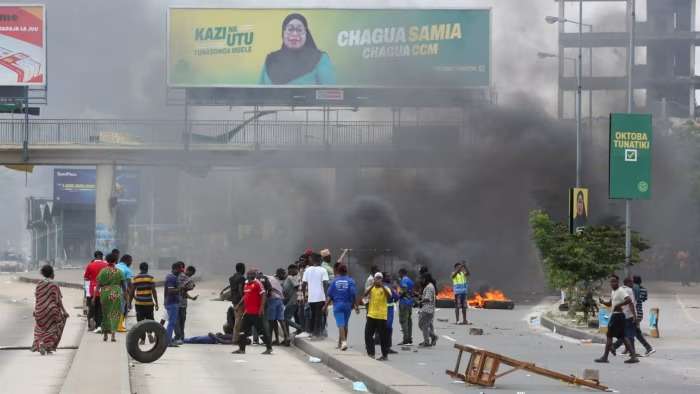
According to international media reports by Associated Press, Al Jazeera, Reuters, and BBC News, protests erupted across major Tanzanian cities — from the Kimara and Ubungo neighborhoods of Dar es Salaam to Arusha, Mbeya, and even the border town of Tunduma.
In Dar es Salaam, demonstrators set a bus and a gas station ablaze, prompting security forces to impose a dusk-to-dawn curfew and deploy the military to key streets, including those housing major media organizations.
Inspector General of Police Camillus Wambura ordered a 6 p.m. curfew, warning that “security agencies are ready to deal with any disruptors of peace.” The government’s heavy-handed response included firing tear gas, live ammunition in some areas, and mass arrests.
NetBlocks, a global internet monitor, confirmed that the country was hit by a “nationwide digital blackout” during the protests, effectively cutting off communication and making it difficult for citizens and journalists to share information about the unfolding events.
Hospitals in Dar es Salaam, including Muhimbili, reported dozens of injuries and several deaths, though the government has not officially acknowledged any fatalities.
Contested Election and Suppressed Opposition
At the heart of the protests lies a deep frustration over what many Tanzanians see as a sham election.
President Samia Suluhu Hassan — Tanzania’s first female head of state — was seeking her first full term after completing the tenure of the late John Magufuli. Her ruling party, Chama Cha Mapinduzi (CCM), has held power continuously since independence in 1961.
But this year’s vote was marred by controversy.
The main opposition leader, Tundu Lissu of CHADEMA, was barred from contesting after being arrested and charged with treason — accusations widely seen as politically motivated. Another major challenger, ACT-Wazalendo’s Luhaga Mpina, was disqualified on legal technicalities.
With the opposition sidelined, sixteen minor candidates were left on the ballot — a move critics said made the race “a one-horse contest.”
“There was no election. It was Samia versus Suluhu,” Karua said. “The elections were boycotted and rigged — even the army was caught ferrying pre-marked ballots.”
International observers were not allowed to monitor the polls, prompting the KHRC to ask: “What were they hiding?”
Human rights organizations painted an equally grim picture of the pre-election climate. Amnesty International described a “wave of terror” involving enforced disappearances, arbitrary arrests, and extrajudicial killings of opposition supporters.
A June UN report also accused the government of “electoral repression” — a claim Tanzanian authorities deny.
Larry Madowo: Why I am not covering Tanzania’s general elections
As the protests continue, attention has also turned to Tanzania’s restrictions on press freedom. CNN International Correspondent Larry Madowo revealed that he was unable to cover the election due to strict regulations on foreign journalists.
Madowo has been at the forefront of covering GenZ protests in Kenya against President Ruto, and therefore many expected him to also cover the Tanzania elections.
“Tanzania does not like independent, critical reporting,” Madowo said in a video statement on October 30. “To operate in the country as a foreigner, I need media accreditation — essentially government permission — and historically, Tanzania does not issue these permits.”
He added that although Kenyans can enter Tanzania visa-free, they cannot report legally without accreditation.
“Could I go as a tourist? Yes. But I am not allowed to report in that status — that would violate the law,” Madowo explained. “Even Tanzanian journalists find it hard to operate. They are harassed and intimidated.”
Madowo said several international reporters who applied for accreditation were either rejected or never received responses, describing the environment as one of “media suffocation.”
A Nation in Crisis
Despite more than 37 million registered voters — a 26% increase since 2020 — voter turnout was strikingly low. Many young voters said they stayed home out of fear or frustration, believing the result was predetermined. “The election was a one-horse race,” said James Matonya, a university student in Dar es Salaam.
Tanzania’s ruling CCM, founded by independence leader Julius Nyerere, remains one of Africa’s longest-ruling parties. While President Hassan initially earned praise for easing some of the restrictions imposed under Magufuli, activists now argue that political freedoms have shrunk again.
Under her “Four R’s” agenda — reconciliation, resilience, reforms, and rebuilding — Hassan promised to restore unity and economic growth. However, the current crisis has raised doubts about her commitment to democratic reform.
Kenyan civil society groups have now urged regional bodies — including the African Union (AU), the Southern African Development Community (SADC), and the East African Community (EAC) — to intervene.
“Tanzania is undergoing a democratic re-awakening, and the youth are being targeted,” Karua warned. “Government critics have been jailed or killed. We call upon AU, SADC, and EAC to protect the will of the people.”
The KHRC also called for global condemnation of what it described as “grave human rights violations” by Tanzanian authorities.
Meanwhile, Kenyan groups announced plans to mobilize citizens in protest of “oppressive legislation” in their own country — linking the struggles for freedom in Kenya and Tanzania as part of a broader regional call for democratic accountability.